The Cult of Individualism: I’m Special and You’re Not.
Thought provoking post.
Book editor and English tutor
When we moved to the Netherlands two years ago, I had only a rudimentary understanding of the Dutch language. A lack of fluency compromises your ability to participate in a culture in the same way smoking too much dope impairs your senses; you know people are saying something that resembles words, but by the time your mind translates for you, the conversation has moved forward. With your language skills on low, you miss jokes. Eavesdropping is virtually impossible and the quick wit and dry humor that help define your personality in your mother tongue are taken away from you in one fell swoop.
It is quite tempting to remedy the situation by speaking English. After all, most people in the Netherlands, be they native Dutchies, Croatians or Spaniards can speak English reasonably well. But to do so means you are missing out on the ego-threatening discomfort and embarrassment that can be the wind beneath your language-learning wings. If you make an embarrassing mistake in a language–asking for your butt instead of the bill, for example– chances are you won’t make that one again. Mag ik de rekening alstublieft? (May I please have the bill?) Mag ik my bill alstublieft? May I please have my butt? (Bil = butt).
Luckily, through exposure and persistence, you reach a point where you understand enough of the words in a conversation to follow along. After two years of daily exposure to frog language, I have reached that level and it has given me a boost of confidence in my daily activities. I can now comfortably eavesdrop on Dutch conversations around me and participate knowingly in conversations. That is until an expression is thrown into the sentence.
And the Dutch are not only very fond of their uitdrukkingen or sayings, they use them prolifically. There are whole books dedicated to the topic and they are also taught in Dutch courses. Seeing as the Dutch are a seafaring nation, many are nautical in theme. For example, if something was overlooked, we might say it’s fallen through the cracks. I’ve heard this used quite often for sweeping government programs that are supposed to help the most needy, but the most needy often “fall through the cracks.” The Dutch equivalent is “tussen wal en schip vallen” or to fall between the dock of a harbor and the ship. So just at the moment your ego is warming up at your level of comprehension, one of these babies is thrown into the sentence. And then your experience goes from head nodding and smiles to what in the ham sandwich did they just say? I understand all of the words, but the meaning escapes me.
I was following one conversation swimmingly until this little ditty came along:”Maak jouw borst maar nat,” which translates to “Make your breast wet.” My mind quickly translated the words from Dutch to English, which left me staring oddly at the older church lady in front of me, wondering if she had a famous Amsterdam profession before joining the church. Before my imagination further discredited her character, I promptly interrupted her. “Wat heb je net gezegd? Maak jouw borst maar nat?” What did you just say? Make your breast wet? A round of chuckles ensued that made me feel culturally cute and ridiculous all at once. Luckily an explanation soon followed. This means be prepared for what’s to come; it’s going to be busy or a rough road ahead.
Every language and culture has its expressions and colloquialisms that can be confusing to foreigners. This is also true in the U.S. Even Americans can be caught off guard by expressions used by Americans from different generations or different regions of the country. For example, how would you tell a friend or family member who was overreacting to a situation to calm down? It depends on your origins. If someone from Southern California needed to convey this information, they’d simply say, “Chill out man.” But if you’re from West Virginia, your word choice may be more like “Don’t go gittin yer gussie up.”
Did you read this whole blog post? Well aren’t you the cat’s meow!
My husband and I were both excited and fearful as our son’s 6th birthday approached. We were excited because our little guy was turning six and his exuberant energy was contagious. We were riddled with fear and anxiety as memories of last year’s birthday party played through our minds accompanied by the mantra of “never again.”
Last year’s “celebration” provided a rather harsh lesson; despite our university degrees and five years of parenting experience, we had absolutely no idea how to entertain and supervise ten little children for 3 1/2 hours. Unfortunately, Ezra had invited one young imp who possessed a sixth sense for knowing when adults don’t have the situation completely under control, and exactly how to make the situation worse. Here is just a partial list of the chaos that ensued: fights, throwing of food, crying, screaming and hitting from the boys; quiet, steadfast politeness and bouts of crying from the girls. The girls, several dressed in princess gowns, looked at us forlornly with their large doe eyes as boys ran screaming around them. The boys, inspired by aforementioned imp-child, ran in multiple directions, disregarding all of the house rules that had been laid out to them. Due to short attention spans and division of interests, games for which we had budgeted 15 to 20 minutes were over in three to five. Thirty-seven minutes into the party, our list of fun children’s activities was all used up and we were at a loss of how we were going to make it to the other side. It took us three hours to clean up and a week to recover.
This year, we prepared for his party as one might prepare for battle: review of past mistakes, strategic planning, ally recruitment, flexibility in the field and a stockpile of munitions. First off, we didn’t invite any imps. Second, we smartly took the advice of my sister-in-law Tinca from the previous year; invite no more guests than the age of your child. Regardless of the much more manageable ratio of one adult to three children, we enlisted the help of Jaana, who had two sons coming to the party, resulting in an empowering ratio of one adult to every two children! Ezra also showed compassion toward his female friends by not inviting them.
We came up with an extended play list of activities that ensured we would never be empty-handed, created a healthy food table with full access and then opened our doors.
I’ll admit that my detailed agenda didn’t go exactly as planned, but the party was an absolute success, void of almost all of the problems we had encountered the previous year.
The best weapon in our arsenal was flexibility. Our first planned activity was  a snowball fight outside, but the boys lingered around the building blocks and found it much more entertaining to walk up the stairs to Ezra’s room, check out his toys and then head back down. Sometimes kids like repetitive actions. Or perhaps they like to explore the territory and see what sort of boundaries are set in place. Boundaries established, the boys were finally ready to proceed with the planned fun.
 Sjoelen was certainly to be a hit. We had access to four Sjoelen boards in the basement of the church and we pictured a thrilling competition. In this traditional Dutch game, a player receives thirty wooden pucks, which he slides down a polished wooden game board, attempting to get them through one of the four slots at the end of the board, thus collecting points. He has two more turns to get the remainder of the pieces through. Usually, you’d have to wait your turn, but with four boards and six boys, it was a dream set up. Yet this old Dutch favorite didn’t hold their attention for more than 10 minutes.
I wanted to do the Monster Game next, something I plucked from my imagination involving my husband being attacked by six little boys at once, but for some reason, Arie Jan wanted to postpone this one for a bit.
Thus we tried a traditional game for which we’d budgeted no more than 10
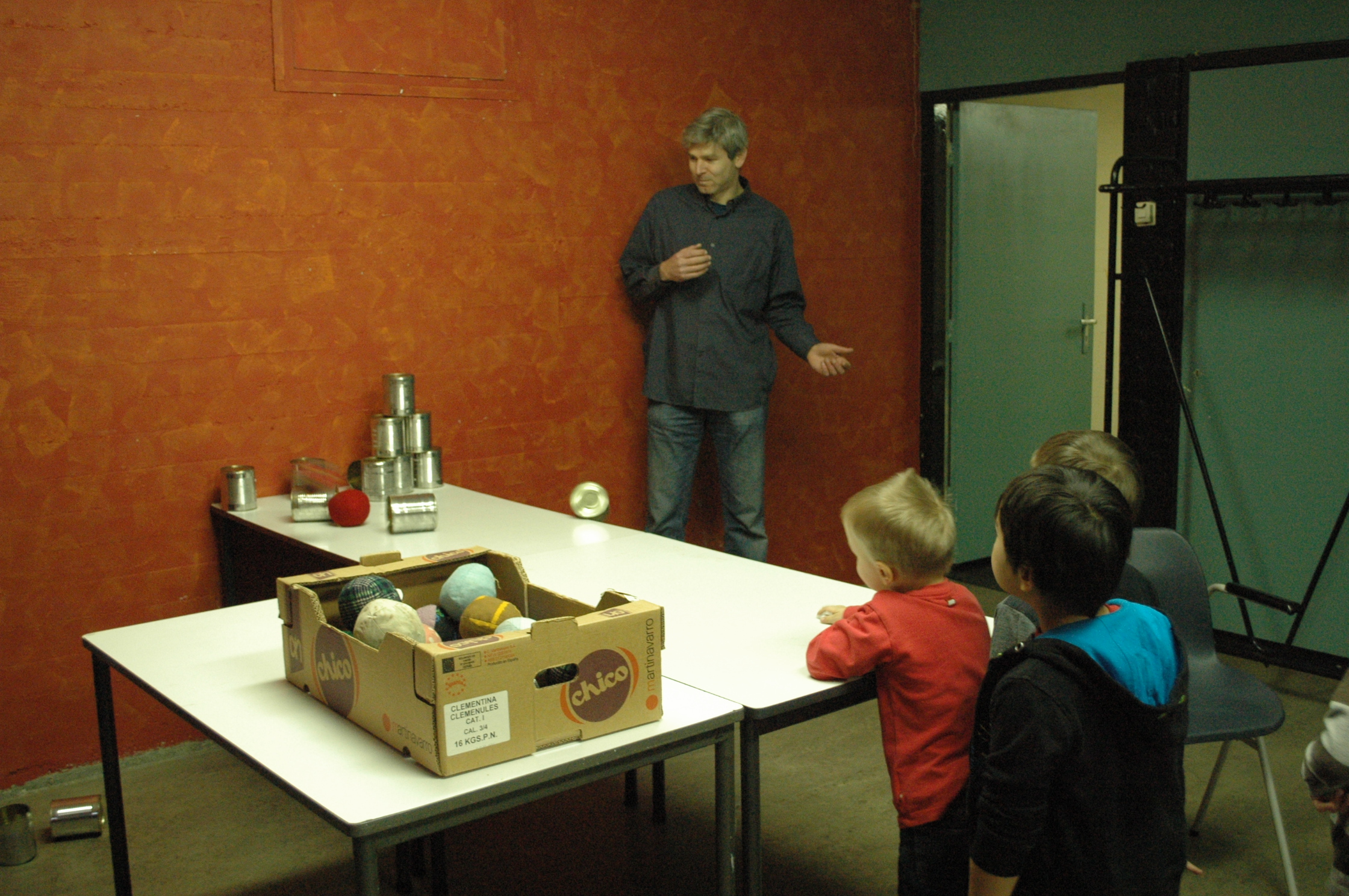 minutes: throwing soft balls at stacked tin cans. Surprisingly, this lasted a good 30 minutes. Boys love the crashing sound of the tin cans clanging to the ground after they’ve demolished them with their forceful throws. And, they love to do better than the next little guy, thus they kept on lining up, wiggling impatiently for their turn.
And finally, the monster game. I’m afraid it was a much too dangerous environment for my camera. But if you ever need a method in which to entertain five little boys (the sixth guest hadn’t arrived yet), this was a hit. First, tell all of the boys that a monster is going to come into the room (point suspiciously at the father of your child). Let them know they will each get three soft balls to throw at the monster and a blanket to help hide. The monster will have five handkerchiefs hanging from his belt. If you hit him with a ball, he has to freeze for three seconds. That’s your chance to grab one handkerchief. But when he wakes up, he can also throw a ball at you and knock you temporarily out of the game. The boy who collects the most handkerchiefs wins.
When the boys heard the monster banging at the door, they were absolutely still. As he made his way into the room growling, they hesitated in their hiding places. But as if by some sort of internal clue, they suddenly attacked. Balls were flying everywhere and the monster was besieged by six little soldiers, all suddenly amazingly accurate in their throws. They all had collective amnesia on the rule about them also getting timed out if hit with a ball, and the poor monster was bombarded. When all the handkerchiefs had been collected, my husband had tears in his eyes from laughter and a grin large enough to compete with those on every little boy’s face.
When we changed pace and came back upstairs for cake and presents, the boys plopped down on the ground within close proximity to one another and worked on building blocks, forgetting all about the cake.
One of the best presents my son received for his birthday arrived the day before his  party–three to four inches of snow. Thus the last official activity of the day, which was supposed to be the first, was a good old-fashioned snowball fight, in which everyone but the birthday boy himself participated.
Last year when parents arrived to pick up their children, they saw two shell-shocked adults who couldn’t push the guests out the door fast enough. This year when parents arrived, they found tranquil little boys sitting around the living room drinking hot chocolate, with tranquil hosts overseeing. Parents lingered for another half hour at the offer of hot chocolate and chatted pleasantly as the boys played quietly together.
This just goes to show; we can learn from our past mistakes and not only move forward, but do so gloriously.
I grew up with the belief that spontaneity is an important element in a life well lived. It was part of my family’s impulsive sense of humor; it played itself out in the creative bedtime stories my mom wove during long summer nights, and it seemed to be the only guiding factor in our summer vacations in the countryside, where each day would slowly unwind with the promise of a new adventure under the California sun.
Yet spontaneity was a seasonal fruit, bountiful only in the summer months when my entire family was free. As mid August hit, it felt like the lazy afternoons were being reeled in on a spool of educational thread, binding us once again to the world of structure. When September arrived, not only did we kids have to go back to school, but our parents as well, one of whom was an elementary school librarian and the other a teacher.
In hindsight, I now realize those spontaneous summer days unconstrained by responsibility were a gift from my parents. While we were out playing Cowboys and Indians, they made sure there was food on the table and clean clothes in our closets, that the irrigation system was working correctly, that the checkbook was balanced and the summer budget on track. They drove us to the library or the beach when we wanted to go, and created all the routines that kept our household humming along while we children played.
Regardless of this adult realization, I still highly value the richness spontaneity brings to life. And that is the type of wealth I would like to instill in my child. But how do you teach spontaneity? Always, always in hindsight. Any other attempt is simply controlled spontaneity, which defies the very definition of the word.
And to plagiarise from the free online dictionary (http://www.thefreedictionary.com); Spontaneous: Happening or arising without apparent external cause; self-generated.
1. Arising from a natural inclination or impulse and not from external incitement or constraint. 2. Unconstrained and unstudied in manner or behavior. 3. Growing without cultivation or human labor.
If you read this definition as a parent, who does it characterize more? You, or your child? I’m guessing your child. Or an earlier, carefree version of yourself you tend to both admonish and admire. Sure, spontaneity can get you into trouble if embraced in the wrong way: giddily jumping off a cliff into a lake for example, going on impulse to bed with a total stranger, or suddenly telling your boss exactly what you think about him or her. But on the other hand, spontaneity connects you to the joy of life; choosing to embrace what you want right in this moment, as a child might do.
And this comes back to answering my own proposed question; my son takes the cake when it comes to spontaneity in every definition of the word. He has an idea and he embraces it. He feels happy and he expresses it through dance, spontaneous song, or silly antics. He wants to build the Eiffel tower and he builds it, molding whatever materials on hand into his desired outcome.
A family art project painfully elucidated an area in which I’ve lost my spontaneity. My son painted a train speeding happily over a bridge, water streaming beneath as the sun shone in the sky. His loose, broad swaths of paint seemed like strokes of genius next to my rigid tree with its evenly spaced fiery leaves. I’d like to think of myself as spontaneous in some way. I certainly give into impulse on occasion. But nothing too daring or scandalous. And there’s the question; Can we, as adults truly embrace spontaneity and also be responsible?
Sure. Within reason. An adventurous friend who I’ll simply call P is a school teacher here in the Hague, is happily married and has two children. She is meticulously responsible and goes above and beyond at work and in the home front. Yet, she admits that she has a fantasy of living the carefree life of her college days with just enough money in her pocket to buy Bruce Springsteen tickets and follow him around the world on tour. In other words, she longs to live life in an unconstrained manner, free of responsibility or worries–be in the moment.
But P doesn’t just admit to the fantasy; she lives it. Every chance she gets, she buys concert tickets and follows Bruce on his European tours, coming home with wrist bands, hip t-shirts, groupie photos, and most importantly, an impish glint of satisfaction in her eyes.
But I was surprised by her words the other day at coffee. To paraphrase, she knows she’s living a lie, but this fantasy gives her the freedom she needs to be at ease in her own life. Is this a form of contrived spontaneity? Living freely without responsibility pressing you down? Being both the benefactor and the beneficiary of your fantasy well lived? I find her solution, contrived or not, an act of brilliance that gives her character peculiar depth.
The number one guru in the art of spontaneity continues to be the almost six-year-old son who is offering wisdom laden lessons on a daily basis. Now if I could only set my adult blinders aside more often to take in his wisdom. On those occasions when I do, he not only connects me with the “I can do anything” mentality of my youth, but encourages me to allow myself that same vision in my adulthood.
Go! Do something spontaneous. And going out for a spontaneous latte grande is not what I’m talking about folks! If you do embrace your spontaneous nature, I’d love to hear about it!*
*(As long as it doesn’t involve shoplifting, stalking, or any gerbil-like weirdness.)
Are you a Christmas lover or Christmas hater? Okay. So it’s not so green and red as that; there’s a whole spectrum of possibilities in between. Perhaps you’re someone who likes all the presents but doesn’t like the religious aspect, or someone who highly dislikes how this religious holiday has been hijacked by consumerism. Or maybe it just stresses you out because you don’t want to be alone this Christmas again, or you don’t feel serious enough about your newest love conquest to bring him or her home to meet the family, but don’t know how to say it. Perhaps you disdain choosing between your spouse’s family and your own. Or you know you can’t possibly buy everything on your child’s Christmas list and want to find the balance between the magic of believing and reality. There are so many possibilities, so many expectations, so many memories that scratch at you like taloned nostalgia, that you fall into a state of melancholy.
Although I’ve been plagued by just about every scenario, I happen to love Christmas. Is this because I was born in the Christmas month? (No, hackers. I will not give you my birthday). Is this because my parents went above and beyond the call of duty to create a cozy, magical Christmas for us each year? Or because I grew up attending midnight mass in the Catholic church, and despite my abandonment of Catholicism, still connect with the spiritual ambiance of this annual ritual? Maybe it’s that I grew up in one of the “nine most Christmassy Towns in America.” That’s right. In 2011, my hometown of Solvang made it into Time Magazine’s list of top nine Christmassy Towns.
And what could my town have over your town to be named such a thing? Without researching the article, I can rattle off at least five reasons; Solvang is small enough to feel like a village; Solvang’s quaint Danish architectural vernacular, with occasional thatched roofs and windmills, resembles a little Christmas village one might expect in a fairytale book; they go all out when it comes to Christmas lighting on its tree-lined streets; it has a year round Christmas store called Jule Hus and finally, Solvang is a place where people come to escape, buy gifts and eat fudge, ice cream and pretzels and drink wine. Interested in knowing what the other towns are? Check out this link.
But wait! You say. It’s not even December. Have I lost my marbles by asking you about Christmas in November? In fact, isn’t that one of the problems? Businesses already breaking out the Christmas gear before we’ve even sat down to Thanksgiving dinner? Most years, I don’t even want to see the colors green and red together until December 5th–at the earliest. But this year I’m being smacked by a wave of holiday nostalgia so dauntingly powerful that it belongs on the North Shore of Oahu with a gallant surfer ripping down its side, not ripping its bottomless sorrow through my heart.
You think I’m being dramatic? I dragged my son to a craft store on Wednesday afternoon so we could buy colored glitter, a bag of assorted Christmas shapes, stamps and blank cards to make our own Christmas cards this year. I’ve never made my own cards, let alone even purchased Christmas cards before mid December. And half the time I only get a handful out in time and then recycle the others, because who’s going to send a Christmas Card in January?
I’ve been calling my friends in America and telling them I miss them. I’ve been desiring Rice Krispies and Orange Julius’s from the mall. I’ve been playing Christmas music. It was particularly pathetic today. Not due to any of my actions, listening patterns or phone calls. I just felt like jumping on a plane and going all the way to Solvang to the Jule Hus store to be immersed in the Christmassy insanity of it all. And then while I was there, driving on over to my parental home.
And then my son came home and cleared things up for me. “Mom. What’s Thanksgiving?” I launched into a condensed version of the holiday and discovered he’d learned about it in school today. “And when is it?” He asked.
“I don’t know,” I said. “Soon.” And then it donned on me why I was feeling so emotionally crushed and distant from the world; why my thoughts were all pointing toward Christmas. It had completely escaped me that TODAY is Thanksgiving. Before you accuse me of living under a clog, let me point out a few things. Thanksgiving is not a recognized holiday over here in the Netherlands. Nothing is closed, besides perhaps the American Embassy. And not one person, the entire day even mentioned Thanksgiving until my son came home from school.
In other words, besides the American expats that band together to honor the day, Thanksgiving as we know it does not exist in the Netherlands. It’s sort of like that old saying: if a tree falls in the forest and no one is there to hear it, does it make a sound? I did not hear the Thanksgiving tree falling.
Now I understand the wave that has been pounding me; I was missing all the cultural, commercial and emotional build up to Thanksgiving and all its trappings of family, friends, feasting and free days that is uniquely American in experience.
This explains my fascination with stockings and holiday cards before you have even sliced the turkey. My mind just skipped on over to the next major holiday and started preparing the way, right on down to the red and green glitter glue. I’d like to say I am living freely, unfettered by the greedy minded consumerist mentality of Black Friday that so often overshadows the meaning behind Thanksgiving. That may be true, but I’d rather be pestered along the way than to completely forget about a national holiday that remains a time to come together with friends and family and celebrate each other. So please, have an extra piece of Thanksgiving turkey for me this afternoon, or evening. Take an extra bite of Jeanne’s homemade peach pie, or Mimi’s cheesecake, or whatever your favorite dish may be that connects you back to your childhood. And savor it.
Usually, when I am so transfixed by a novel that I can not put it down, it’s in the non-literary genres of romance or mystery. These fast-paced novels are like monosodium glutamate for the mind; the mind keeps ingesting the words, regardless of quality and integrity, until the words are all gone; the woman has the man; the killer’s been caught and the mystery solved. Afterwards, you life is not improved, but it sure was a fun ride while it lasted.
The selections of my Expat Book club, on the other hand, are the steamed broccoli, high omega fish and long grain rice of novels. They provide thought-provoking literary journeys that not only offset your binge reading, but may even make a healthy contribution to your world view.
And thus, when I headed to the American Bookstore to purchase The Room, the latest Book Club selection, I anticipated another literary journey. I approached this novel as I approach most of the selected books for my Expat Book Club–buy it last-minute without much background on the subject matter and dive right in. But I truly believe, had I known the subject matter of Emma Donoghue’s The Room, I would have never cracked it open in the first place.
The Room deals with a horrible topic; an experience you would not wish on your worst enemy. And yet, it is so incredibly well written, and the characters so real, that you cannot will yourself to put it down. This inability to step off the ride is not in that junky, horror film way. It is as if through the very act of reading, you are a spirit watching and willing the main characters to not only survive, but to break free and overcome their insurmountable situation. Yet you do so from a safe distance; outside of the page, outside of their world. They, on the other hand are locked inside and you desperately want them to be free.
The majority of the book is presented through the innocence of a five-year old boy. And even though you read with your adult eyes, and realize what he has not yet been able or willing to realize, you are drawn into the innocence of the world his mother has created for him. And as the situation grows more desperate, you read on as if for the sake of humanity itself.
You may be tempted, like I was, to flip to the back of the book and see what happens with the characters. Because if they aren’t going to make it through, why on earth would I want to invest the time reading about something so awful? Well, because ignoring it won’t make it go away. Being aware of how easily something like this could happen could perhaps wake us all up a bit more; keep us on our toes. Not locked in fear or obsessing about what ifs, but on our toes; aware; looking out for ourselves as well as others.
I know I’m being vague. I know you can Google The Room by Emma Donoghue right now and figure out what it’s about. But if you do, you’ll rob yourself of the journey. It’s heavy. You may even feel sick at times. But if you just keep reading all the way through, you will come out on the other side with a sense of hope. Hope and possibly the desire to find out what you can do to help eradicate this very real situation that affects far more people than we’d ever care to admit.
When I was in high school, I worked at a leather store; not the type of leather store you find in a strip mall, but a family owned, first generation, hands-on business. The owner was a transplant from the East Coast that had a running commentary on politics, attended jazz concerts and often waned semi philosophical with clients. His store offered an eclectic mix of hippyesque leather goods such as hand carved leather belts, Indian moccasins and fringe leather jackets, as well as luxurious lamb’s skin leather mini skirts, full length fur coats and hip bomber jackets. Racks of stylish leather hand bags, wallets and hats filled every last bit of space. Somehow, these items created a cohesive collection, which fit the upscale name, First Street Leather.
In the morning when I opened the store, the intoxicating smell of leather filled my senses, confirming that I had stepped into a world of perceived luxury. Over time, I learned to accurately size someone up when they walked in the door–not in a sense of casting judgment, but in knowing that this particular man wore a size forty-four coat, that woman most likely a size seven boot. I learned to speak confidently with strangers, no matter their walk of life, and to refrain from judging a book by its cover–a skill that has proven surprisingly useful throughout life. For example, the rough and tumble man in black leather biker chaps with a red bandana tying back his long, windblown hair was just as likely to pull out a thick roll of hundred-dollar bills to purchase a fur coat for his babe, or go sentimental over his child, as was the man in the tweed jacket and corduroys.
But what proved more poignant were two other concepts I was introduced to by the owner of First Street Leather: that activism is for everyone and that life is short. Activism in those days required a bit more hands-on work. Like actually writing a letter. On several occasions when it was slow, he had me hand address envelopes to leader’s of other nations.
“You’ll need to do this one over.” I must have sighed out loud in a way only a teenager can, because he went on to explain why exactness was in this case so important; “When you’re writing the President of Sri Lanka to voice concerns over human rights in his country, you can’t make a mistake in the spelling of his name. Otherwise, he won’t take you seriously.” Indeed, I had misspelled the last name of then-President of Sri Lanka, Junius Richard Jayewardene.
My boss was also outspoken. One time, when a woman passed him doing 80 on a windy country road, he followed her for 20 minutes until she pulled over, verbally chastising her driving style. Nevermind that he had to copy her dangerous driving to catch up with her. I had no intention of emulating his style of standing up for what you believe in, but the lesson was clear; speaking up for what you believe in is not something you can do from the sidelines. It takes commitment and decisiveness, and not everyone will be pleased with you along the way.
The other lesson I learned from him was that people sometimes go before their time. He had just turned forty, and suddenly friends of his started to die; friends in the middle of successful careers, friends with young families, friends who had been in perfect health one day, and were suddenly gone the next. I could see that my boss was still fit, quick of wit and very capable, but at the time, forty sounded ancient to me. I was, after all, of the invincible age of sixteen and had more than two and a half decades to go before I’d be so darned old.
But what struck me was the melancholy that settled over him as he mourned his friends, and how uncomfortable it made me feel. He was my boss–someone who I expected to always be strong, decisive and right. It seemed that with each friend’s passing, he probed the holes that suddenly existed in his web of life connections–connections that had played a role in forming who he was. Perhaps he felt his own mortality. And no matter how vital and strong you are in daily life, you become vulnerable if you probe such darkness–especially if you don’t believe in a happy afterlife. Although there were two tragic deaths of fellow schoolmates during my high school years, they were shocks that startled me. And although I may have contemplated how short life could be, it did not stick with me.
Now that I’ve reached the ripe old age of forty something, his melancholy comes back to me in a wave. Friends and acquaintances of mine have made the journey to the other side, and thus far I’ve received no postcards telling me how it is over there. Watching the news is a daily reminder of just how short life is. Yet it really hits home when someone from your youth, a thread to your vibrant beginnings, passes away. Especially if it is before their time. Such is the case with former classmate Kim Denuzzo. Although we were not close in high school, she was this positive force in our class–always friendly, upbeat. I went on Facebook to peruse what was up with my friends, and discovered that Kim had suddenly passed away–in the middle of her life, leaving behind her family. Saturday October 6th was her memorial.
And so it begins. She is not the first in my life to pass away. There have been many. And I know, being the mortal humans that we are, that the numbers will only increase. But what is comforting is the faith she had, and the solid feeling that comes to me that her rich life energy is celebrating somewhere else. Faith can make all the difference for those left behind as well. If you believe you will see Kim again, or your friend, father, grandmother, whoever it may be, the blow still comes, but is softened with such eternal hope.
And what else happened on October 6th? Two new friends of ours, also vibrant life forces, got married. And somewhere in the world, babies were born, someone made love for the first time, someone ended their marriage, another got his dream job, yet another received an extension on life through a transplant, and so forth and so on. I suppose these musings are also a part of melancholy. But to explore life’s processes in earnest is not a form of weakness as I thought in my youth. It’s about gaining strength that will carry you forward in life.
When we flew into Schiphol airport outside Amsterdam, I had a great sense of relief: Relief that the long plane ride was over, excitement to see my husband again, and the shoulder-relaxing sensation of being back home. And there I’ve said it. Home. Usually, that’s a term I reserve solely for central California, the place where I grew up and where I just spent the last five and a half weeks staying with family and friends. That is the place where people speak my language. Not only the English language, but Central-California-Coast English.
In this particular liberal leaning dialect, all know that the Monsanto Corporation, with their genetically modified crops, is evil; that gay rights are inalienable rights; that tomatoes and blackberries are things to be picked fresh off the vine and eaten immediately; that open space is a valuable commodity that should be preserved; live music a treasure to the soul, humor a form of religion, and speaking wittily, yet openly and kindly with others a way of life.
After spending five and a half weeks in California, I almost felt like I’d moved back home. Almost. The problem was, my sweet husband hadn’t come with us. He was back in The Hague, holding down the fort, working on the house, skyping and calling us every other day, and reminding my son and I by his mere absence, that we had another home on the other side of the ocean. The incredible sunshine, cultural familiarity, friends, family and all the charms that “my California” offers are far more compelling than the most creatively designed sales brochure or million dollar ad campaign. Nothing can sell you more than being understood, comfortable and wanted. And a big part of me wanted to stay.
Yet, now that I’m back in The Netherlands, I want to be here too. Not only because my husband is here and my job is here, but because our three-level apartment in The Hague has become our home away from home, the school Ezra attends his school and the people we’ve met our other community. Perhaps I’m a much simpler creature than I want to believe, and one of those hand crocheted little wall hangers that says “home is where the heart is” sums up my ability to transition so easily from one culture to the other. Or, maybe I’m just culturally slutty in that seventies, free loving, Crosby, Stills and Nash “Love the One Your With” way.
In either case, neither world is perfect. Here in The Hague I can ride public transport, walk or bicycle to just about anywhere I need to be, providing me the rare ability to avoid car culture altogether–a virtual impossibility should I live back in California. If I want the European experience, I only need step outside my door. If I want a European vacation, I need only a free weekend to venture by train to another city, or country, for that matter, and gaze upon breathtaking town squares from the 1600s, something I can also do in my “home away from home” town.
On the other hand, although Arie Jan picked up quite a bit of CCC English during his six years with me in California, I haven’t met anyone else who truly speaks my dialect. On top of that, I communicate most of the day in a foreign language I haven’t yet mastered, meaning that I feel held back, and unable to fully express myself. Yet there is something exciting about the daily challenge of language acquisition. It is as if my every waking day is a treasure hunt, and every person I interact with potentially the one to offer up a new Dutch word, that upon that day transitions from a word I keep forgetting, to one given over to my permanent collection. How would you weigh being understood immediately compared to a daily treasure hunt?
And more importantly, where is home? Where is my home away from home? And which city becomes my home away from home away from home? I would never want to be described as two-faced, because of course that expression holds only a very negative connotation. But I do have two worlds in which I reside. And when it comes down to it, I’m leaning much more heavily toward the promiscuous approach to my two cultures of Love the One your With.
On the flight over for our month long stay in the U.S., I tried to prepare myself mentally for the differences between America and Holland. But as I thought about the differences, only generalities came to mind: the U.S. is a more car-oriented culture; there’s less use of public transportation; there are hardly any bike paths except on university campuses; people are still addicted to big cars; the majority of the architecture is post 1940s.
But when we went through customs, met my brother outside of LAX and hopped into the car to head out of Los Angeles, I didn’t feel any sort of culture shock. Instead, I slipped right back in as if I’d never left. Car oriented culture seemed natural. The dry California landscape was certainly in great contrast to Holland’s rainier and thus greener climate, but it didn’t shock. It is just what I know. I guess a year and a half is not so long of a time to be away after all.
I asked my Dutch friend Marjon, who has lived in California for over a decade, what it is like for her when she goes back to Holland for summer visits. Her experience was very similar to mine. She simply slips back into Holland life and ways as if she had never left. My other Dutch friend Tessa expressed the same experience.
Perhaps this is why the term expat exists, and why expat cultures thrive. We are formed by the culture in which we are born and raised. And even if we spend years abroad, the original culture is imprinted on the foundation of who we are. Once an American, always an American. Once a Dutchie, always a Dutchie. Once a “fill in your nationality of choice,” always so.
Just this morning, after a week back in my homeland, I realized there are things I miss about my fellow Americans, things I had earlier taken for granted. I went for a power walk early this morning through the neighborhoods surrounding my brother and sister-in-law’s home. Everyone else out and about waved to me, gave me a nod or said hello. It didn’t matter if it was a young Latino man jogging on the other side of the street, a black man out walking his dogs, or a white woman opening the blinds to her home; they acknowledged me as another human being in their scope of vision. I haven’t had that experience in The Netherlands. Not even once.
Of course this is a phenomenon mainly experienced in neighborhoods. It happens rarely on busy city streets or major tourist corridors. But I’ve walked in neighborhoods of Holland, and when my eyes meet those of another, I am only met with a stare or a sense that someone is gazing right through me. I think I must have stopped saying hello, or giving that little nod that at least acknowledges another human being.
Thank you stranger Americans for your friendliness. And speaking of friendliness, I have been greeted with a smile in every place of business I have entered in the last week, and I am served with what comes across as genuine friendliness. I believe we are just a friendlier nation.
After a week in California, I’ve transitioned from “yeah, of course. This is just the way things are,” to a sense of appreciation for the little differences between my homeland and my new homeland. Ah, but the vacation is still young! I’m sure some other less impressive American traits may be just around the corner for me to encounter and remember.
This slideshow requires JavaScript.
As I prepare for my first solo trip with my son to the U.S. for a month long visit, lessons learned from our last vacation pop into mind. Below is the beginning of a blog I started after our five day May vacation: a low budget, whirlwind trip to Luxembourg, France and Belgium.
Luxembourg
An unscientific yet plausible way to measure your stress/chill ratio is to go on vacation– with a small child. The number of days it takes to let go of work and other stresses is the exponent of your stress. I discovered one dimension of the stress/chill ratio while sitting in a canopied restaurant deep in the valley of old Luxembourg. The moment I completely enjoyed the Estaminet Premium Pils passing over my lips, while being not in the least annoyed that my son was filling my shoes with tiny pebbles, I had reached chill.
I’d like to say that on our May vacation I stumbled into chill and stayed, sucking up the foreign landscapes with the voraciousness of a crisp piece of bread descending into French Onion soup. But I didn’t. I vacillated between relaxed and mildly anxious about some nameless, yet poignant stress residue.
Oh Grasshopper, you might say, it is one of life’s great challenges to stay in the moment. Or if you were feeling wise but less sarcastic, life will always present stressful situations. It is how you react to these situations that will determine your stress/chill ratio.
And I would answer with my own scrap of truthful triteness: knowing these truths and acting upon them are two very different things.
The first morning when I awoke in Bertrange, Luxembourg in our friend’s guest room, I felt the relaxation percolating through my cells. Not one wayward client plodded through my mind.
I must attribute part of this relaxed state to our host, Wim. When we arrived at 1:15am the evening before, he waved to us from his balcony. He welcomed us warmly and showed us to our quarters, making no fuss of our ridiculous arrival time. In the morning, he was gracious and relaxed as if he too were on vacation, not headed out the door for a long day’s work. His calm demeanor not only made my son feel at ease in an unfamiliar house, but set the tone for the day.
As we headed into the City of Luxembourg, the corset of stress I didn’t realize I had been wearing slowly unlaced, string by string. By the time we parked the car in the deep valley of Luxembourg filled with old buildings and warm sunshine, I thought I had cast the corset aside. We walked along an old stone wall, an ancient city river below us and a high train bridge above. Sections of the old city topped by cornflower blue sky were elegantly framed in its arches.
“This would make a wonderful picture, don’t you think?” I said as I retrieved my camera. I’m on vacation. It’s sunny. Life is good.
“Yeah. If you want to take a shot that’s been done a million times before. It’s hardly original,” commented my husband. I’d like to say I responded calmly, saying how I thought his comment was inappropriate. But no. Anger rippled through me and the imaginary corset, far from cast aside, constricted my ribcage, causing me to cough.
I can’t tell you exactly what words I spewed at him, but they were far from a shining example of the Non Violent Communication skills we’ve been trying to incorporate into our communication. This one little incident might have put a damper on our day had it not been for our son who snapped us back into the present with his glee and ability to be completely in the moment.
At other times, he was the little winged creature setting flame to my fuse. But both situations give you a chance to assess your stress. The deeper we settled into our vacation, the fewer times I found myself being reactionary.
France
When we opted for the low-budget motel in Nancy, France, rather than the architecturally refined lodging adjacent to a central monument, I experienced no longing. Instead, I followed my son’s lead.
“This is our new home! Look at the bath tub! Let’s take a bath and you can tell me a Scooby Doo Emmet and Ezra Ninja story in the bath tub.”
Cheap plastic drinking cups transformed into submarines and we taught orphan baby sharks how to hunt. After a leisurely bath and a stint at watching French adventure cartoons, we walked to the center and passed through the golden edged entry gates of Stanislas square. http://www.ot-nancy.fr/uk/centre_historique/place_stanislas.php
The Netherlands has beautiful squares with brick buildings and inviting terraces, but Stanislas square, built in the 1700s, presents an intentionally royal atmosphere. Designed to honor Louis the XV of France, the three-story white classical buildings with golden detailing exude nobility. Lavish fountains and golden gates catch the light of the street lamps throughout the square. It is a place to not only fall in love, but to fall in love with France.
As we dined in the square under the stars with hundreds of other tourists, the sun slowly set, washing the square in the deep magenta hues of a romantic evening. My son had his french fries, I, a large salad, and my husband ordered something called “steak tartare.”
As we waited for our food to arrive, sipping on chocolate milk, white wine and beer, the locals entertained us. No street musicians, but drunk university kids rushing fraternities. They ran around awkwardly, some smeared with paint on their faces, others arm in arm, escorting young men who should have stopped drinking a few flasks ago.
And then dinner arrived. French fries: check. Scrumptious salad: check. Steak tartare: what the hell? I stared at my husband’s plate and started to laugh.
“That looks like chopped up raw steak!” I gasped.
“It is,” he said calmly.
“And what’s that ocher yellow sauce next to it?” I asked.
“Raw egg yolk,” he mustered with less sarcasm. My husband likes his eggs over hard. Not sunny side up. Not easy. Hard. Not a single wiggle from the egg yolk.
“It’s very French,” he said. “And you have to get that look off your face if I’m going to be able to eat my dinner.”
I’m not sure what my look was, but I’m sure had he taken the shot, it would have been captioned “gastronomic horror.”
I did take a shot of his dinner (see slide show).
We rounded the evening off by standing in line with the other tourists from around the world for a scoop of ice cream, and then chasing Ezra around the regal square. The walk back to the hotel took us past flowing fountains, down stone lined streets, and then into the more modern, car lined area of our hotel. I’m guessing my sound night’s sleep in our cheap hotel was only somewhat attributable to a decent mattress. The rest? I was with my beautiful family, relaxed, and at peace after our glorious evening in Nancy, with more travel adventures on the horizon.
And Belgium still lay ahead! (I had written a long portion on visiting castles in Luxembourg and on Metz, France, but somehow, wordpress didn’t save it! The gothic cathedral and beautiful candles in the slideshow above were taken in Metz. If I have the heart, I’ll recreate that entry at another time. It is a stunning city worth writing about.)

 kristininholland