Breaking bread with refugees


Something kind of amazing happened in the last few weeks here in The Hague. Robin de Jong, who works for STEK, created a think tank to come up with ideas to welcome the refugees from Syria, Eritrea and other countries who are temporarily housed in our neighborhood through December 31st, 2015.
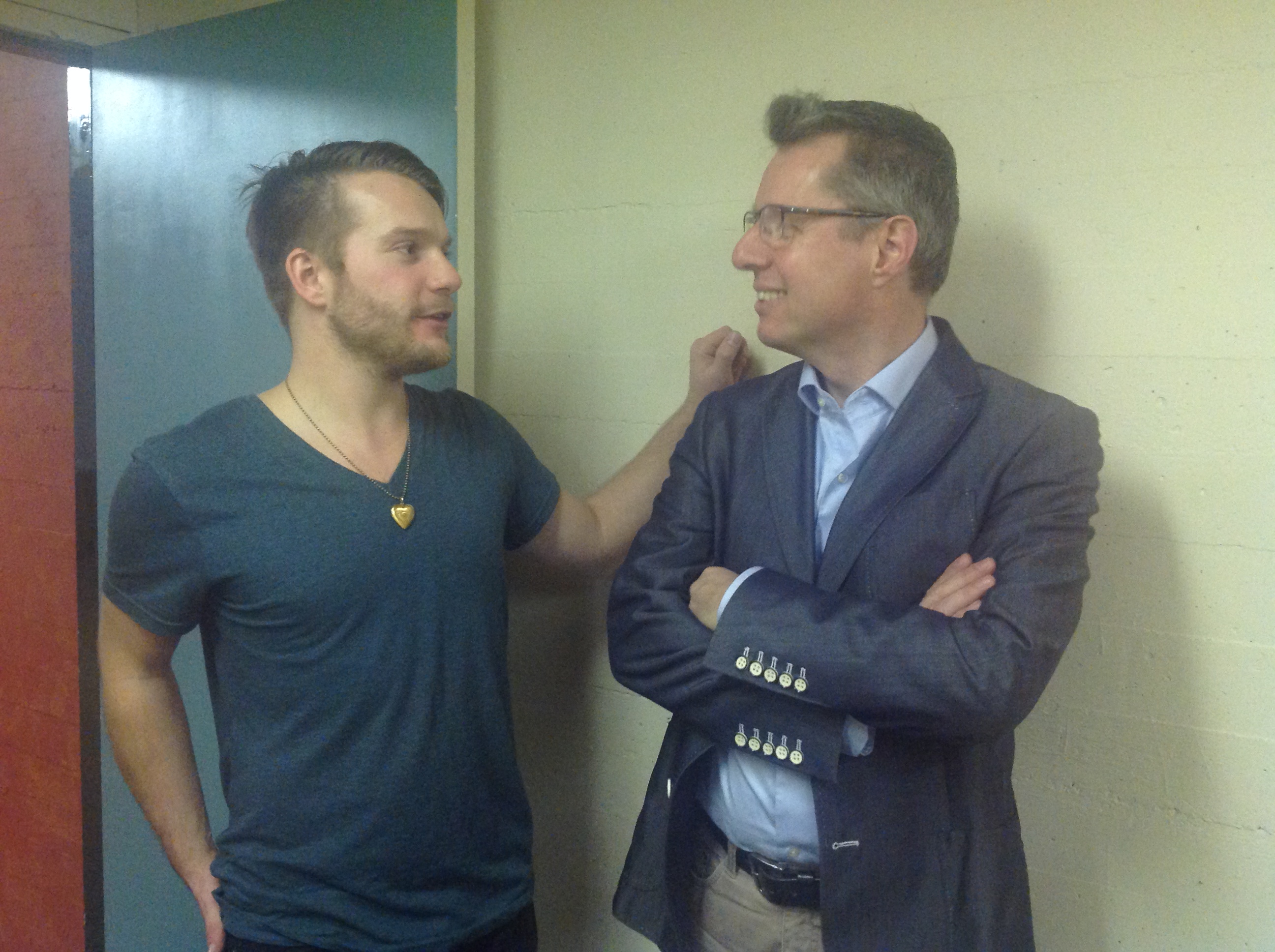
Robin de Jong, STEK and Minister Ruud Stiemer, Christus Triumfatorkerk

The think tank quickly brought together ministers from multiple churches and other organizational leaders to brainstorm on the best way to help this population within a short time frame.

Thing is, groups like this, despite their best intentions, quite often get bogged down by finding a date that works for everyone to gather, proposing ideas to church boards or government organizations, trying to get budgets approved, waiting for responses, etc. But because the 600 refugees in our neighborhood are only here for a total of 6 weeks, we had to act swiftly . . and we did!

Multiple events have been formed in the last few weeks, from concerts and high teas, to shared meals and exercise programs. But this post is mainly about a meal that changed my perspective about the refugees.

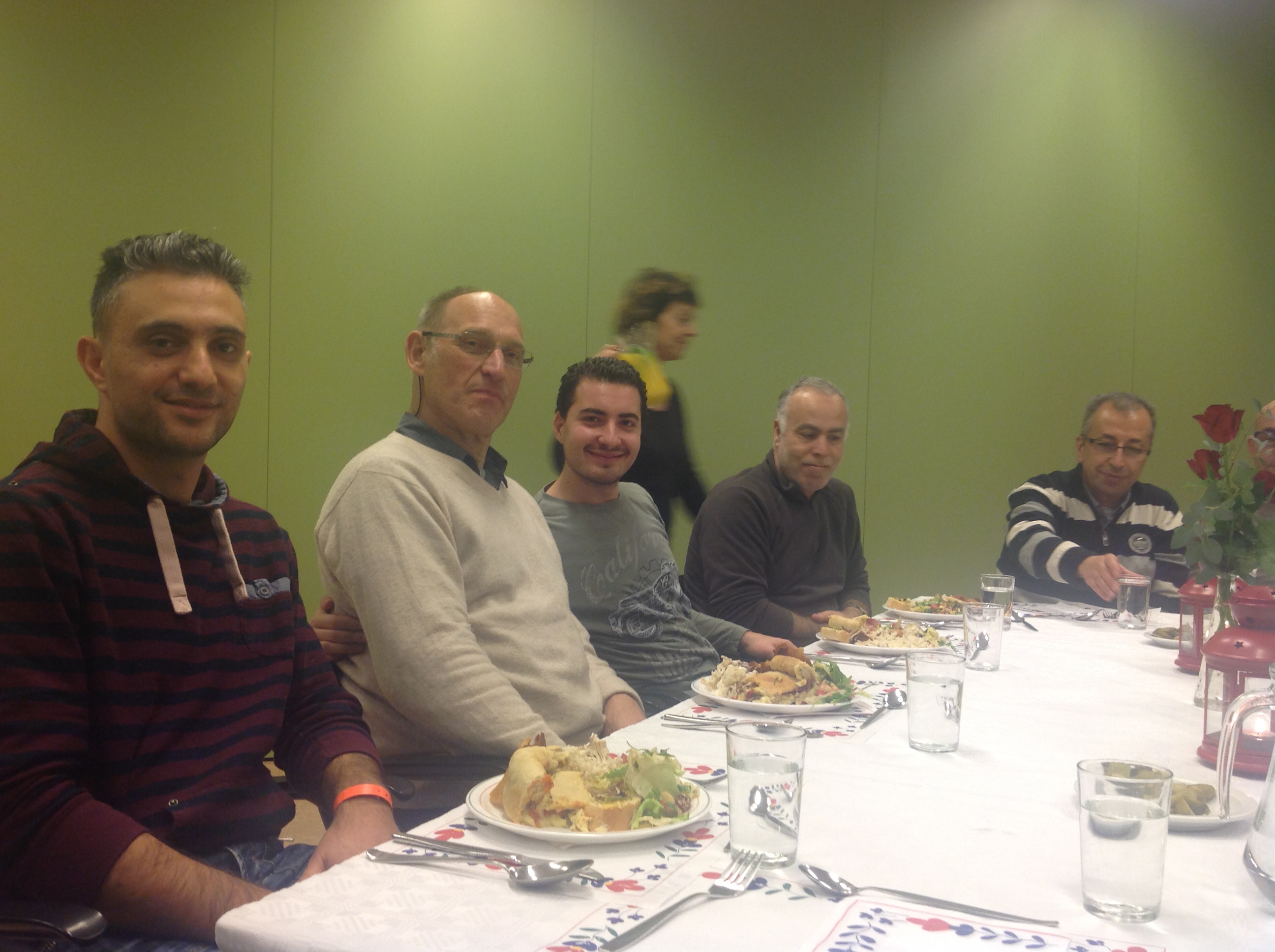
This past Monday, we organized a dinner for 30 refugees and 30 people from the neighborhood in our church with a theme of bringing people together to break bread and learn about each other as individuals, rather than as concepts.
IMG_6199
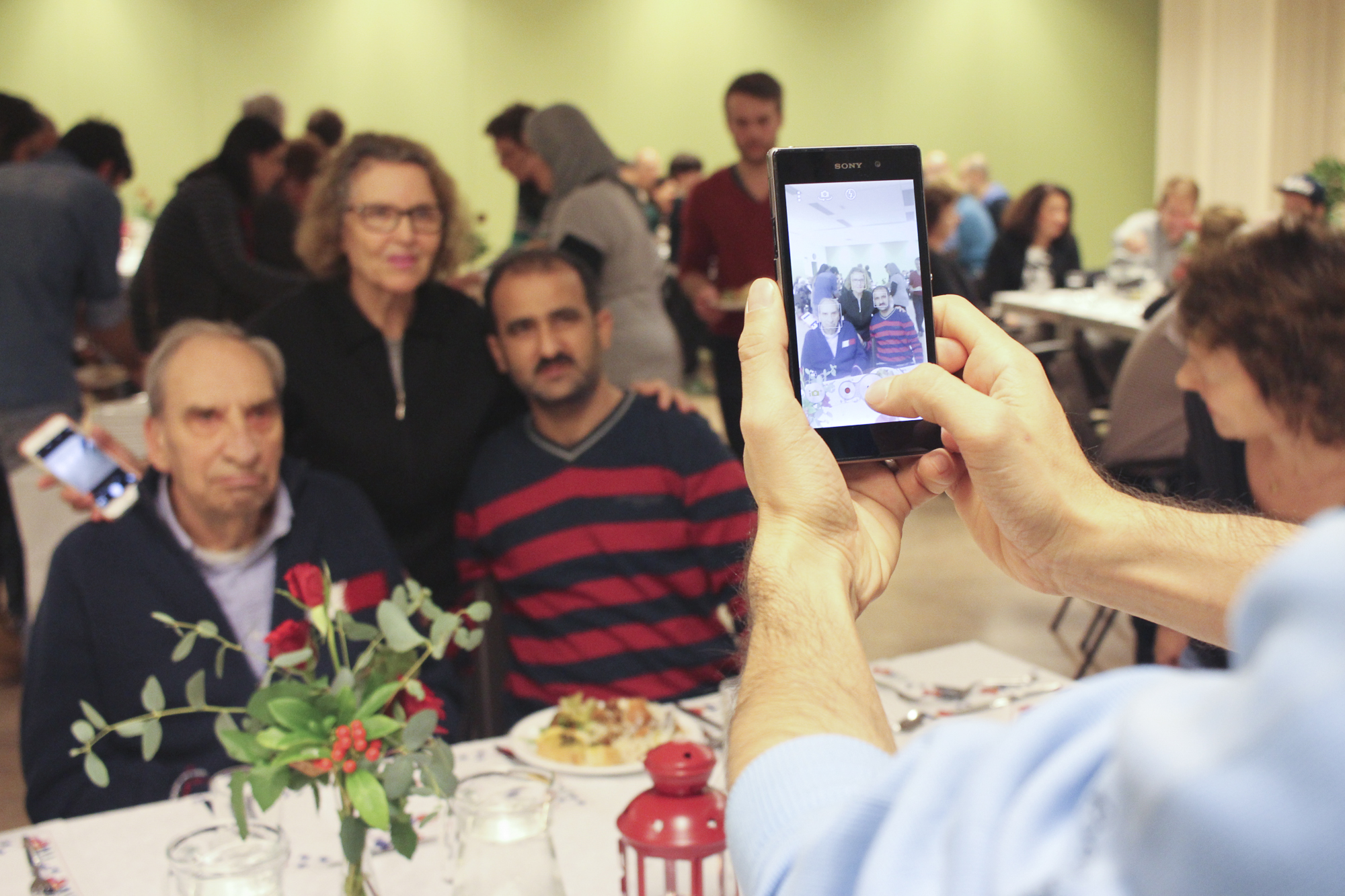
Refugees and neighbors from the area sharing a meal together.

In other words, a “refugee” and all the preconceived notions we might have formed about them via our exposure to the media, is replaced by a table mate who is a real person with a name, a history and stories to share. And “we”, their temporary neighbors or potential future countrymen, are also transformed from strangers to people who look them in the eyes and listen to them speak, whether it is about their favorite foods, a fiancé back home, or their trials in fleeing their war-torn nations and leaving loved ones behind.

2015-12-07_maaltijd_CTK_34
Syrian chef Tarik (That’s rosemary from my garden in his pocket!)

The Hague branch of Vluchtelingenwerk, who helps support the refugees, found out that one of the refugees was a chef from Damascus, the capital of Syria. Before long, we had enlisted him to cook an authentic Syrian meal and recruited a few more refugees to work as translators from Arabic to English.

Friends of ours who come from Arabic nations who are fluent in Arabic and Dutch also volunteered to help cook. The Diaconie from our church, and Bezuidenhoutfonds both made financial contributions. More volunteers from the neighborhood as well as our own cook and volunteers from the weekly meal made for the elderly enlisted to help. In other words, people from five different cultures, multiple organizations and committees came together to quickly turn an idea into a reality.

As one of the organizers, I was a bit stressed, wondering if we could pull off this kind of event in one week’s time. We sent invitations around via e-mail, asking everyone to share the invitation with anyone they thought might want to register. A few days before the event, we had all 30 slots for the refugees full, but only twelve neighbors registered. A bit more recruiting and the list began to grow.

2015-12-07_maaltijd_CTK_37

The evening of the event, we had 35 neighbors and 35 refugees turn out for the shared meal. The refugees were thankful to be outside the center, grateful for the food and all of the effort, and pleased by the chance to interact with others.
2015-12-07_maaltijd_CTK_42

The neighbors who signed up felt thankful for the opportunity to interact and connect with this group of fellow humans who have been through such harrowing experiences, but are still surprisingly upbeat and willing to share their stories.

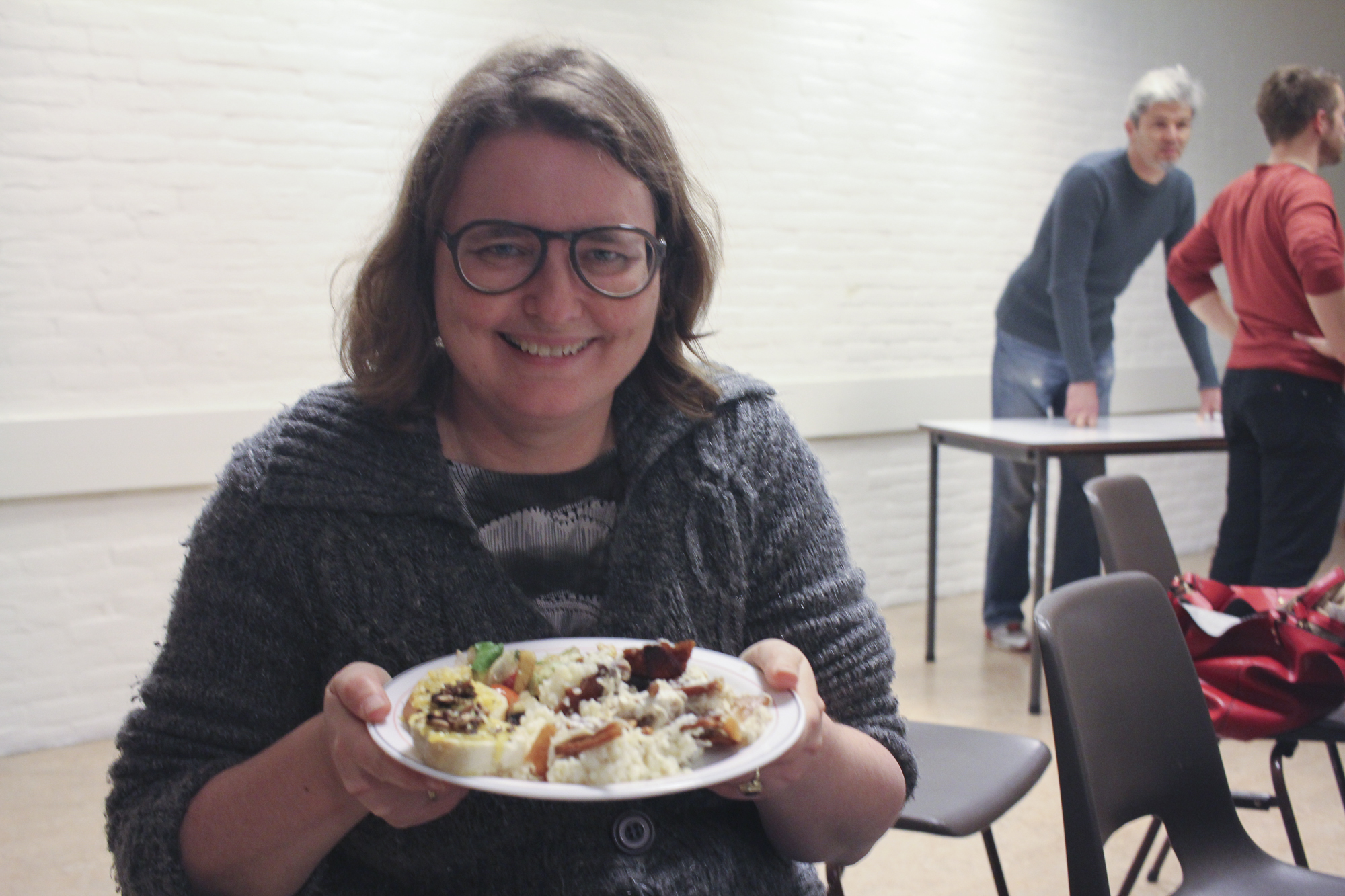
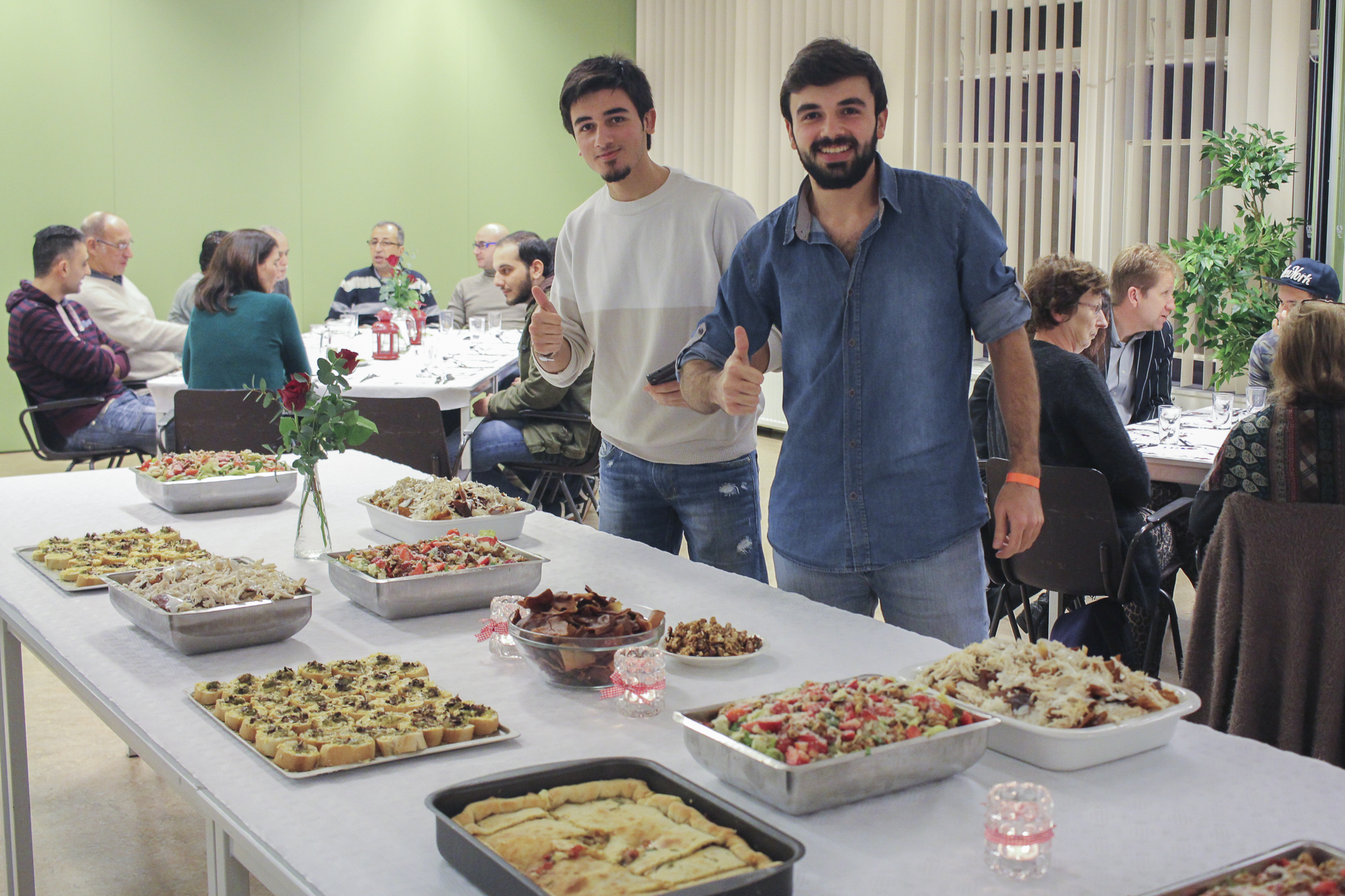
And Tarik the chef, who cooked from 10:00am until 6:00pm at night without stopping, did an amazing job of turning out a delectable buffet of authentic Syrian dishes.

Photos courtesy Frouckje van der Wal

2015-12-07_maaltijd_CTK_36 2015-12-07_maaltijd_CTK_562015-12-07_maaltijd_CTK_52


2015-12-07_maaltijd_CTK_40


Word must of spread, because our second planned “Maal en Verhaal” is already completely sold out!

It wasn’t until a few days after the shared meal that I realized the significance of such an event: I see with different eyes. Fears are dispelled. You read the news differently and think about “the other” differently. You realize that acts of kindness, compassion and understanding are the steps needed to understand others and create common ground across cultures and beliefs.

I hope that if I have to flee my country–whether it be from a war, extreme poverty or a country made uninhabitable by drought or flooding from climate change–I pray that others receiving me as a refugee will recognize me for what I am: a person just like you with a desire to pick up the pieces and live my life.

Not everyone is pleased that the refugees are here. However, goodwill seems to be outweighing the negativity born of fear.

Other great events are popping up all over the neighborhood, including an action to provide a Christmas dinner for all 600 refugees spread out in six different churches and businesses.


The Refugees are Coming


A friend once shared a famous quote with me as if he’d thought it up himself: The only constant is change. This very straightforward, yet difficult to accept concept is attributed to Heraclitus, a Greek philosopher dating back to 500 BCE.

Somber philosopher Heraclitus from Ancient Greece

I’ve become very familiar with this ancient concept as I moved from one state to another while living in the U.S.; one country to another in the last five years. I’d like to say I’m somewhat comfortable in that role of constant change, but I’d be lying. Knowing change is a constant and embracing it are two very different things.

One major difference of living in the U.S. and living in Western Europe, is that if you read the world news, a lot of the world events happening are much closer by. It is harder to keep that healthy (?) distance between events unfolding two countries over, and you are confronted–for better or for worse–with how interconnected the world is.

Nothing could bring this point further home than the current refugee crisis. It’s not so much a crisis, but an End of the World as We Know it. Don’t take REM’s word for it. Don’t take my word for it. But take the World Bank’s and the International Monetary Funds’ words for it:

As migrants and refugees from Africa and the Middle East continue to arrive in Europe in unprecedented numbers, a new World Bank/IMF report says that large-scale migration from poor countries to richer regions of the world will be a permanent feature of the global economy for decades to come as a result of major population shifts in countries. (World Bank Report, October 7, 2015)

Is this some vague, far away concept? Hell no. The refugees of war and poverty, the immigrants who see no future in their home countries, are flocking to Europe in record breaking numbers, and many European nations are flying by the seat of their pants trying to figure out what to do with these humans, even though this sort of fluctuation has been long predicted (for about 20 years!) as an unavoidable result of inequality and poverty.

The Netherlands must be employing it’s expertise in flood management, because

Photo credit: http://www.welingelichtekringen.nl/

despite the fact that this tiny country of 17 million is already densely populated, they are converting empty government buildings into housing; informing residents of refugee shelters coming into their neighborhoods and implementing other strategies to address the human flood of hopeful future Dutch citizens.

One such conversion of an empty government building into a refugee shelter is happening four blocks from my house, where 600 refugees, mostly men, will soon receive temporary shelter. In January 2016, the building will be renovated for longer term housing for refugees who gain status to live and work in the Netherlands.

Is this a good or bad thing? It depends on who you ask. As soon as the city found out that the COA* had decided to turn this building into a shelter, they responded by sending a letter to residents in the immediate neighborhood. Despite the two day notice, over nine hundred citizens showed up to hear about the new shelter.

According to an acquaintance of mine that attended, about 40% were against the idea of this shelter (NOT IN MY BACKYARD) and 60% were not only in favor, but there to see how they could help.

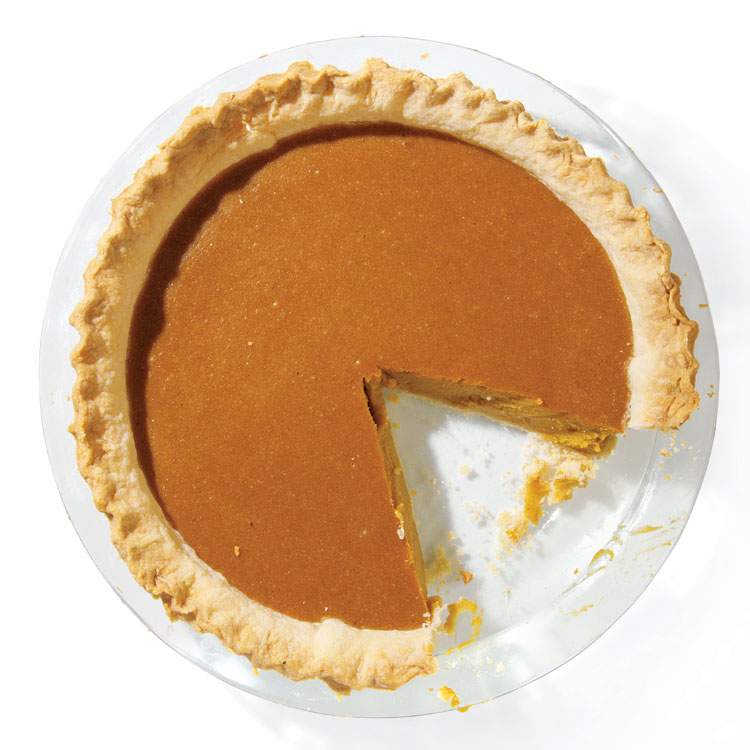
For all of those who view the refugee presence as a threat, I understand. They are putting a demand on already limited resources; asking us to share a piece of pie we 7-SAV151-HomeSlice-750x750were pretty much planning to eat on our own. We have no idea of the long-term ramifications, and our current optimism may burn out as we realize this is not a temporary thing, but a culture change.

Change is scary. Change brings out fear. Fear is a strong motivator. In fact, in most cases the very motivator that sent these humans–not so very different than ourselves–fleeing in rickety boats across a rough sea. They’d rather risk their own lives, than stay where they were. That is a human flood as inevitable as the floods brought on by global warming.

I for one am excited that the refugees are here. Perhaps naively so, perhaps rightfully so, but this “refugee issue” is no longer in a different country, in a different city, but right here at our doorstep, and the majority of the people in my community want to help. I’m not talking about knitting afghans and letting them eat cake. I’m talking about assessing their needs, rather than guessing at their needs, and coming together as a community to serve those needs, while not undermining our own. As in all things, keeping the balance.

And on top of that, the World Bank report goes on to say that this population shift “while posing challenges, offers a path to ending extreme poverty and shared prosperity if the right evidence-based policies are put in place nationally and internationally . . . ” (Read the full article here.)

Perhaps the joke will be on me and I won’t be as flexible as I tend to think I am. Maybe I’ll be the one clinging desperately to the way things are now, but if that happens, I’m just going to crank up the REM and give a nod to Heraclitus to remind me of how things are, and go with it.

  • COA = Centraal Orgaan opvang asielzoekers–Central Agency for the Reception of Asylum Seekers.
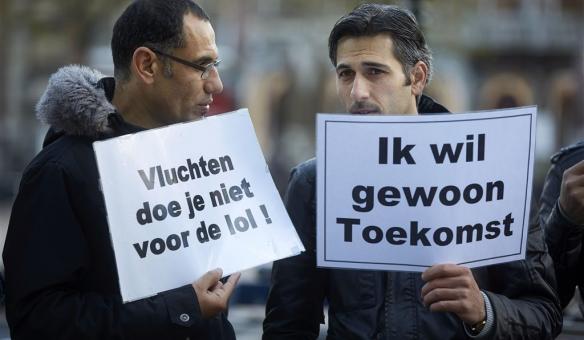
  • Translation of text on pictures: Ik wil gewoon toekomst. “I just want a future.” Vluchten doe je niet voor de lol. “You don’t flee just for kicks/ for fun.”

TC Boyle and the Shadow of Fame


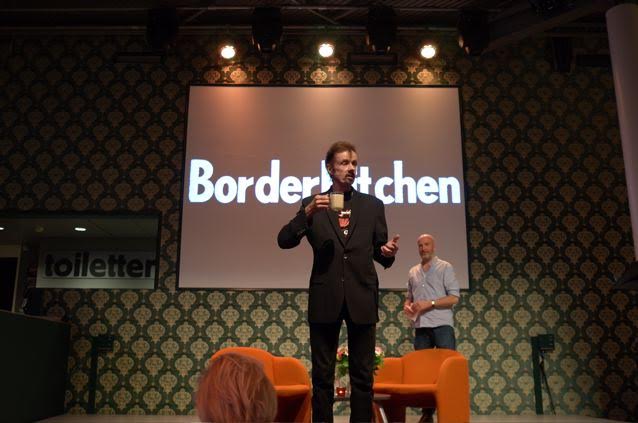
Tonight I attended a Border Kitchen event held at Theatre aan het Spui in The Hague to hear TC Boyle speak about life, writing and his latest book “The Harder They Come.”

I’ve only read two novels by TC Boyle: “Riven Rock” and “Drop City.” I immensely enjoyed both novels and believe TC Boyle to be one of America’s great contemporary authors. Despite the years that have passed since I’ve read these books, their characters occasionally appear in my mind as vividly–and in some cases as disturbingly–as someone I’ve met in person.

TC Boyle at Border Kitchen event. September 3, 2015. Photo courtesy Eleonore from Canada.

When I arrived there weren’t many seats left, but I managed to join two ladies at a table. I headed to the counter to grab a cup of tea before the event started. I was selecting my tea bag when I noticed someone standing close to me at the counter, mixing milk into his tea. I looked up to see T.C. Boyle an elbow length away. He saw me in his peripheral vision and we looked at each other, struck up a conversation. I’m not sure who spoke first, but our initial exchange went something like this.
“Hi.”
“Hi.”
A strange and stupid shock ran through my body, as often happens when you meet a celebrity. I felt heat, discomfit, became aware that nothing intelligent was flowing from my lips as we chatted. He mentioned his jet lag. I was properly sympathetic. I asked him if he still lived in Santa Barbara and he said yes. I explained that I used to live there. He asked what I did here in The Hague. I provided a mundane reply about my work, mentioned my Dutch husband. I shared nothing about being a writer, or that it was strange to talk to him in person, since he has been inside my head, though many years ago, through the muse of his characters; will most likely be in my head once again after I purchase his latest book.

Perhaps that is why I felt weirdly off kilter, despite his casual friendliness. He has been inside of me. I realize that sounds overtly intimate. But it is not far off. Have you ever read a book where the characters stick with you? Seem multi-faceted enough to actually be the flawed humans that we all are? But with a book, the intimacy of knowing a character goes deeper; it is a voyeuristic experience where you are privy to their thoughts, candidly know their fears, and if written well, are sympathetic to them despite the fact that they are horrible people; or are inspired by them even though they do not exist. But they exist, I believe, in a collective way. Whether they are an amalgamation of impressions of different people wrapped into a well-researched historical character, or completely fabricated by the author, they are distinctly human and live a life of their own.

Do we ever experience this level of intimacy with our friends and lovers? Certainly. Because our friends and lovers are real people with whom we can interact and a fictional character created by an author following a muse is nothing compared to a real person. Why then, do characters stay with us over the years? Why do we have whole academic degrees about literature that spend hours analyzing the characters presented by authors as if they are real people that offer insight into the human condition? Because they do. Because humans have and always will relate to stories about the individual.

Just like real people, T.C. Boyles’ characters have riled me up, made me question humanity, feel emotions far more complex than singular brushstrokes of anger, love or compassion.

What intrigues me about T.C. Boyle is that he does not shy away from topics that make most of us squirm and close our eyes: racism, murder, schizophrenia, environmental issues, controversial eradication of wildlife to name a few.

I learned this evening that his latest book “The Harder They Come” is based upon a real person who murdered two people. Although he thoroughly researched this person; read through all the newspaper articles and reports of the homicide, he never interviewed anyone. In fact, he doesn’t interview people for his writing, and has taken the liberty of writing about real people without ever actually talking to them.

To summarize something he said this evening: Any person that has been heavily written about in the news is fair game for writer’s of fiction.

I’ve never thought of it quite like that. If you write a fictional account of someone, you are neither representing or misrepresenting them. You are creating a parallel universe in which they exist, and we, as author and readers, breathe life into this alternate universe by the act of participating in the story, letting it unfold inside of us.

Based on his wild look and the usually intense content of his books, I had wrongly assumed that T.C. Boyle would be an introvert with a secretive, introspective cast to his eyes as he addressed the audience. Oh. Far from it. He was funny, irreverent, yet polite. When he settled down a bit, his intelligence and insight into what it means to be human shone forth from behind the humor, and I understood why I must expand my T.C. Boyle reading collection. That won’t be hard, considering he has written 25 books, 150 short stories and countless articles.

I’m not sure what got into me, but as I stood in line to get his signature, I wanted a photo with him. I noticed the woman in front of me had a camera, and boldly, timidly, I asked if she wouldn’t mind taking a picture of me with the author. Her name was Eleonore and she was gracious enough to honor my request and send the photos this very evening!

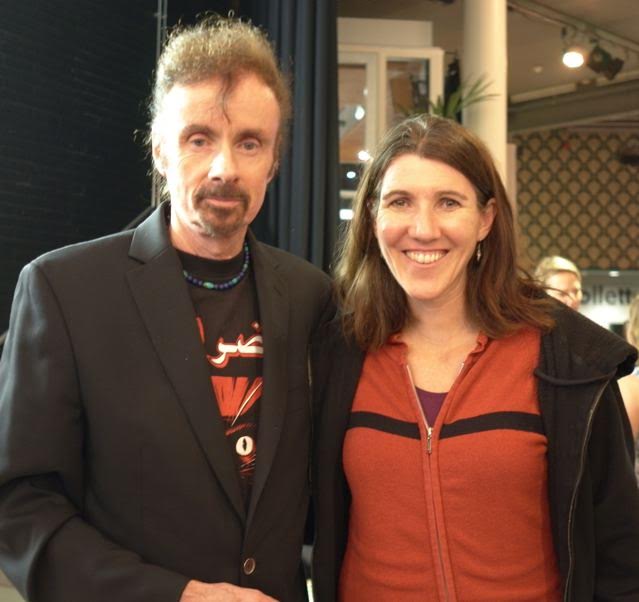
Author Kristin Anderson with author TC Boyle. The Hague, September 2015. Photo courtesy Eleonore from Canada.
Author Kristin Anderson with author TC Boyle in The Hague, September 2015. Photo courtesy Eleonore from Canada.

What I walked away with this evening is a renewed sense of faith in the value of literature to society, and a desire to further my career as an author. I’ve published one book, so technically I already am an author, but what about becoming a full time author? Creating fertile soil for my creativity through a daily practice of writing, researching, exploring character, finding the muse?

I know: Keep the day job. But tonight’s reading with TC Boyle was like fresh kindling under the 19th century idea of finding my own personal patron. A patron of the arts who wants to sponsor me for three years to turn my fledgling career into a serious author of contemporary literature. It is as if being in the mere shadow of fame inspires you to search out the light; dare to dream.
Thanks Border Kitchen! Thanks TC Boyle.

The Nappy of Jesus


I’ve lived in The Netherlands for four years now and have never been to Germany. It’s not from lack of desire or some repressed cold-war hostility I hold onto as an American. On the contrary, I have German friends; I admire German efficiency and quite often covet German-made products. I also hold certain vague notions of what Germany is like. Considering we live so close, it would be nice to have a chance to turn notion into first-hand observation; to develop feelings for a place based on experience, rather than my brother’s crazy German punk friends from university days, snippets from the news and early childhood televisions choices like Hogan’s Heroes.
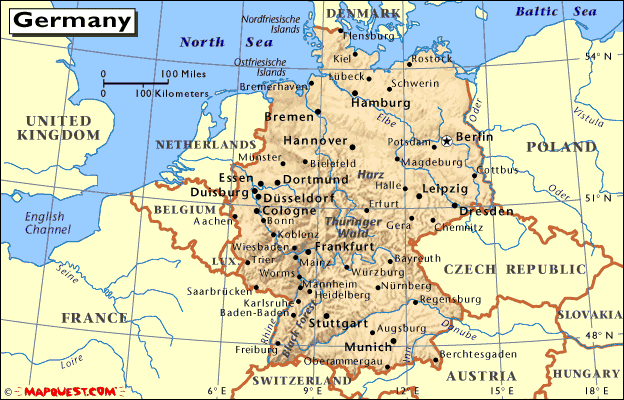
So when I discovered that my son’s free Friday happened to fall on the same weekend as my free Sunday, I knew I wanted to get away for a weekend, and I knew I wanted it to be in Germany. After much deliberation, studying of train schedules and distance, we settled on Aachen, a city very close to the border of The Netherlands and Belgium.
Don’t see it on the map? It’s just over the Belgian border, and the name on this map is, strangely enough, placed right beneath Belgium in the yellow of this neighboring country.

germany map twoI knew we were in Germany the moment we transferred trains. Not only did I hear the German language all around me, but I also noted how clean and roomy the German trains are. We checked into our clean and orderly Ibis hotel in Aachen and headed into the old center, home to cathedrals, museums, printen laden sweet shops, many a fountain and the centuries-old influence of Charles the Great, or Charlemagne.
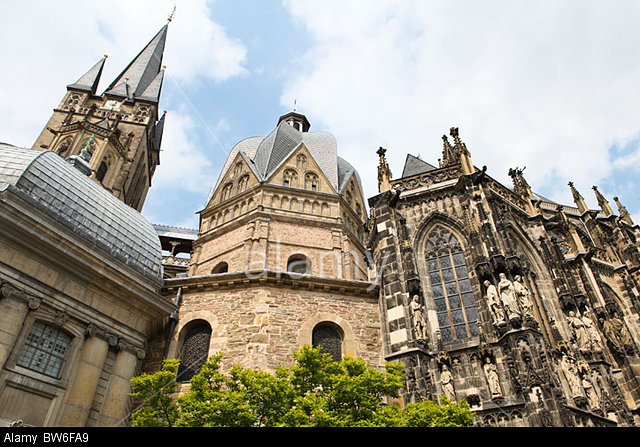
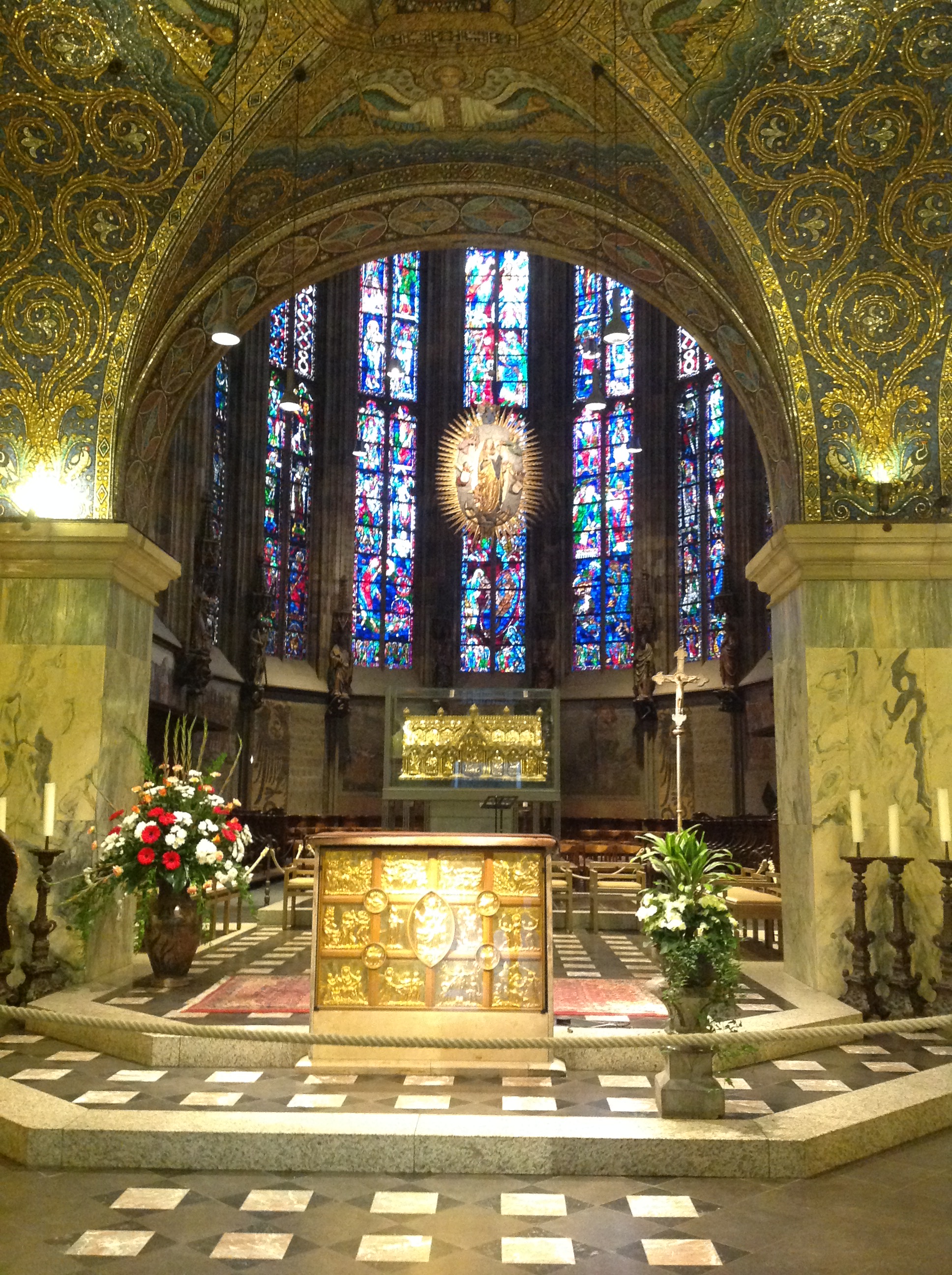
This formidable figure, despite being dead for over 1200 years, is still the star attraction in Aachen. As if proving the point, our first stop was the Imperial Cathedral– the oldest cathedral in Europe and the final resting place of Charlemagne.

BW6FA9 Aachen Cathedral, http://c8.alamy.com/comp

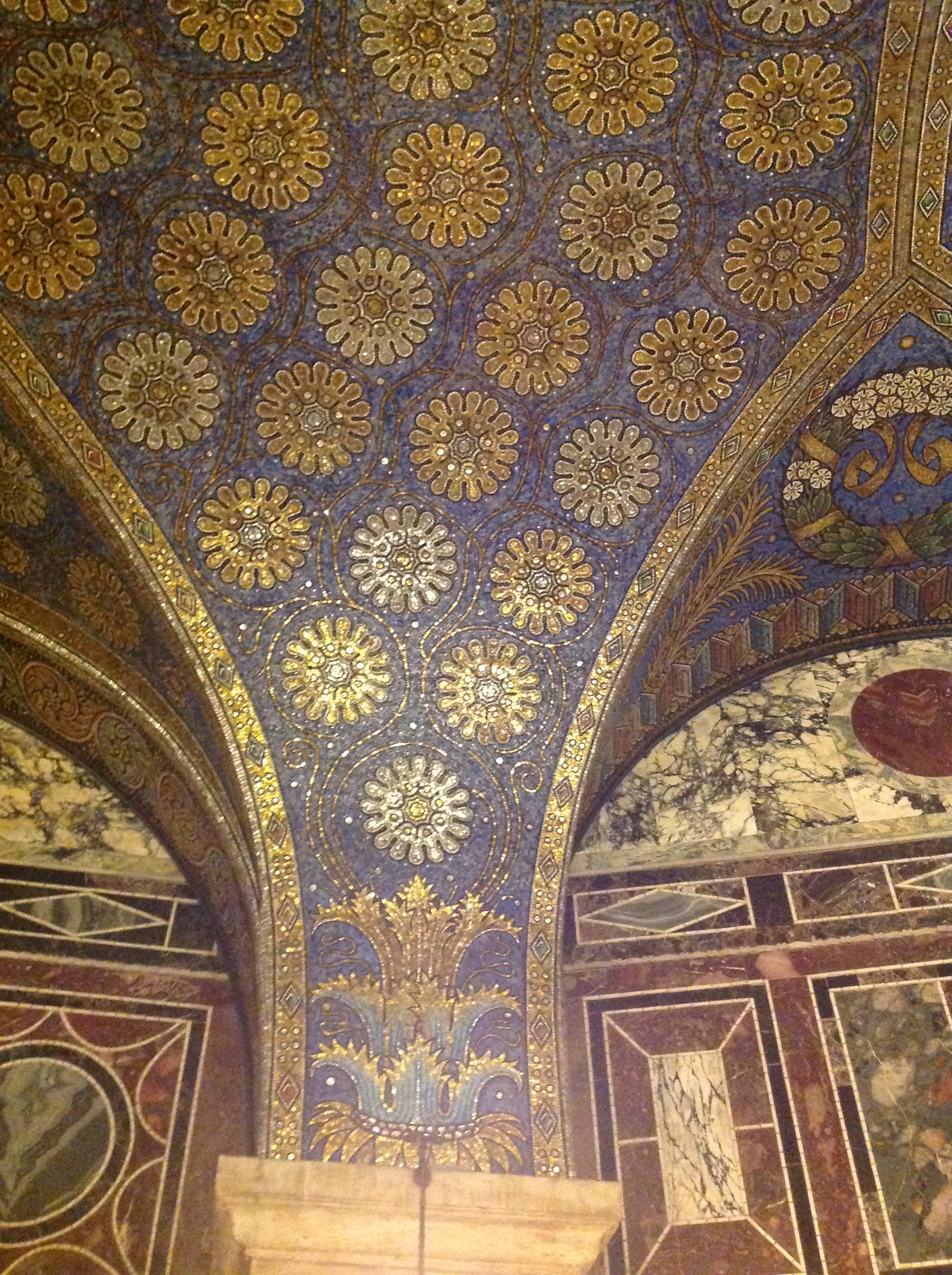
Many Catholic cathedrals I have visited have chaste marble or stone columns that seem to be intentionally subtle in color so as not to take away from the grandeur of the stain glass windows, marble statues, and golden chalices associated with Catholic mass. But clearly, it wasn’t always that way.

arches and columns with organic patterns, Aachen Cathedral interior

The intricate tile work on the interior columns and ceilings of the Imperial Cathedral, has an exquisitely exotic feel to it.

Another striking difference of being in Germany was the eating experience. I was impressed with the presentation and proportions of the meals. We had delicious food served by friendly wait staff. In addition, the proportions were 30% to 50% bigger and at least 20% cheaper than what you would pay in The Netherlands.

Because time was short and we had done so little research due to the spontaneous nature of our trip, we decided to go on a guided tour of the town’s ancient center. Our guide, a blonde-haired, blue-eyed German with a mediocre command of the English language led us slowly through the medieval streets.

Water seemed to be the central theme of the tour. Aachen, a spa town with sulfer spring water acclaimed for its healing properties, has been visited throughout the ages by important figures, from Kings, generals and Duchesses to movie stars.  “Let us go meet the water,” she announced, as she led us within the domed pavilion bordering the tourist office. We met the water by running our hands under a stream of water coming out of a wall-mounted faucet above a bronze basin.

Aachen is also known as the City of Fountains. Although we only saw a handful on our tour, we could understand their appeal. Each fountain seems to have its own message or social commentary built into the design. One fountain with a a constant circular flow is lined by bronze statues, each figure depicting a human relationship with money: greed, poverty, sharing, receiving, profiting, etc. Eliminating any chance for subtle irony, this fountain is called “The Circulation of Money,” and the construction of this particular fountain was sponsored by a bank.

Another fountain, called the “Puppenbrunnen” was surrounded by characters with moveable arms and legs. IMG_4312Each figure represents a certain aspect of Aachen society, from a church figure and knight, to a presumably poor older woman with rotting teeth. Our guide informed us that the locals say her teeth are rotting due to all the “Prenten” she has eaten over the years.

My favorite part of the tour was when the guide sat us all down on a stone bench with a commanding view of the Imperial Cathedral on the far side of a grand square. Although the tourist office guides are not allowed to lead tours within the cathedral, they can certainly discuss some of the highlights at a distance. She explained among other things, that this beautiful cathedral is the oldest in Northern Europe; that many kings and queens were coronated in this cathedral; the unique octoganal geometry at play in the Palatine chapel within and that it is where Charlemagne is buried.

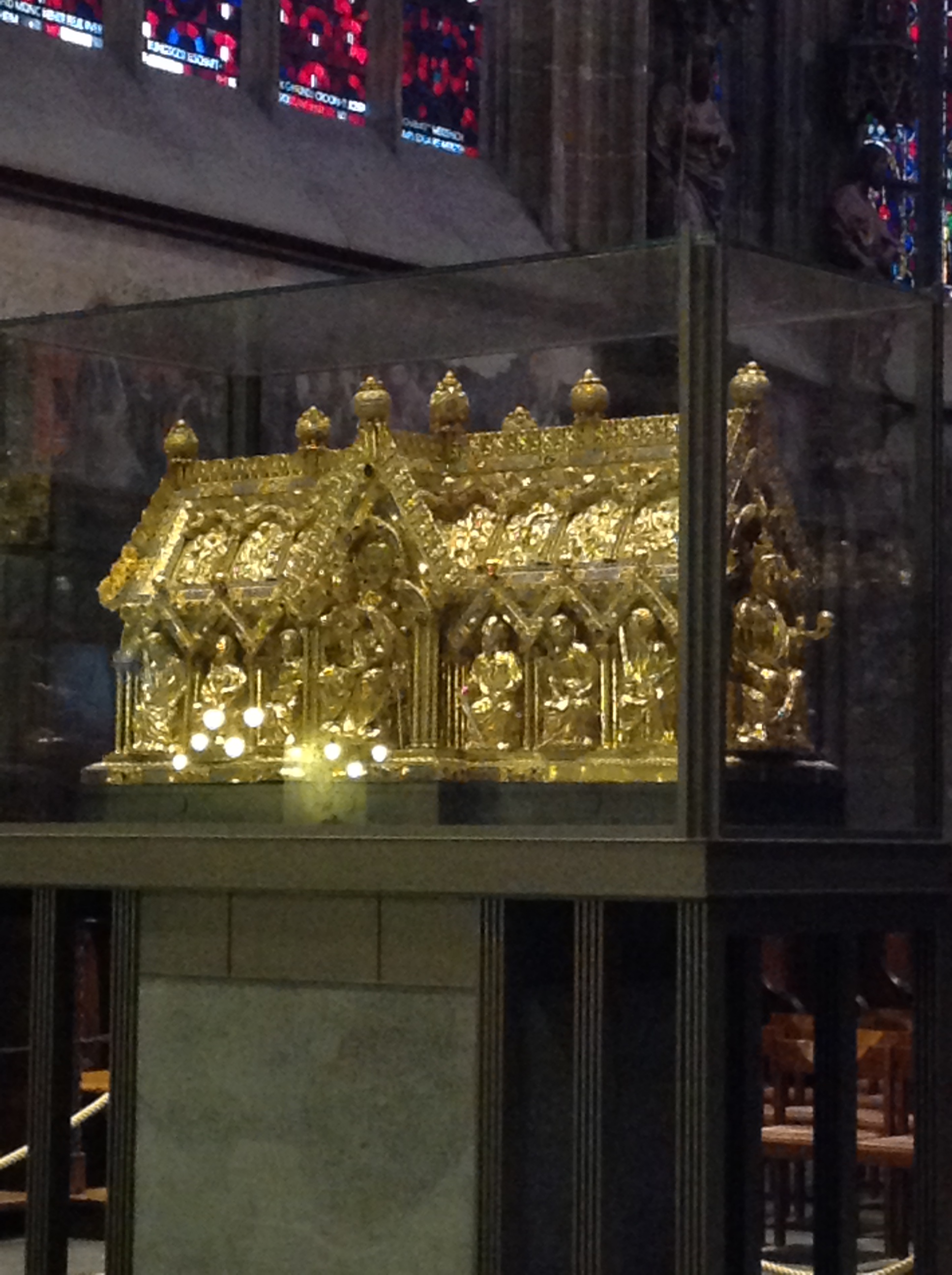
Then she proceeded to tell us about the important relics housed within the cathedral in a golden box, otherwise known as the Marienschrein.

Marienschrein in Aachen Cathedral

IMG_4272

“Inside are special relics that are only on view to the public during pilgrimages to Aachen. For example, it holds the dress of Mary and the nappy of Jesus.”

She didn’t seem surprised that her announcement was met with laughter instead of oohs and aahs. One British man on the tour repeated her claim. “The Nappy of Jesus?” he mocked, an incredulous expression on his face.

“Yes,” she confirmed. To the Brits, nappy means diaper, not men’s undergarments. But she insisted that her information was correct.

Wikipedia, it seems would concur with our tour guide: The relics include: the nappy and loin cloth of Jesus, the dress of Mary and the decapitation cloth of John the Baptist, which have been shown to the congregation and to pilgrims participating in the Aachen pilgrimage every seven years since plague struck in 1349. ~Wikipedia discussing the contents of the Marienschrein.

Is it time to edit this Wikipedia entry, or is nappy truly appropriate? And what will this do for the reputation of Jesus? I can already hear the jokes now. He wore diapers as a 33-year old? Mary was really hanging onto his childhood.

Easter Art, Todd Anderson and Nature


Art is everywhere: In museums and galleries, on the wall of your home or dentist’s office. I enjoy visiting museums and cherish my 90 seconds of interrupted viewing of the great masters before I have to make way for the next museum visitor. I am equally intrigued by the Rembrandt’s in the Mauritshuis as I am the Mondriaan’s in the Gemeente Museum. But I am particularly attracted to Landscape paintings. They draw me in to the idea of nature, quite often from a bird’s-eye or mountain- top view.

Landscape by Todd Anderson, USA

Perhaps this favoritism has to do with growing up close to nature. But if you think about it, nature is the original artist (or God, if you are so inclined).

Santa Ynez, Calilfornia (photo credit: Todd Anderson)
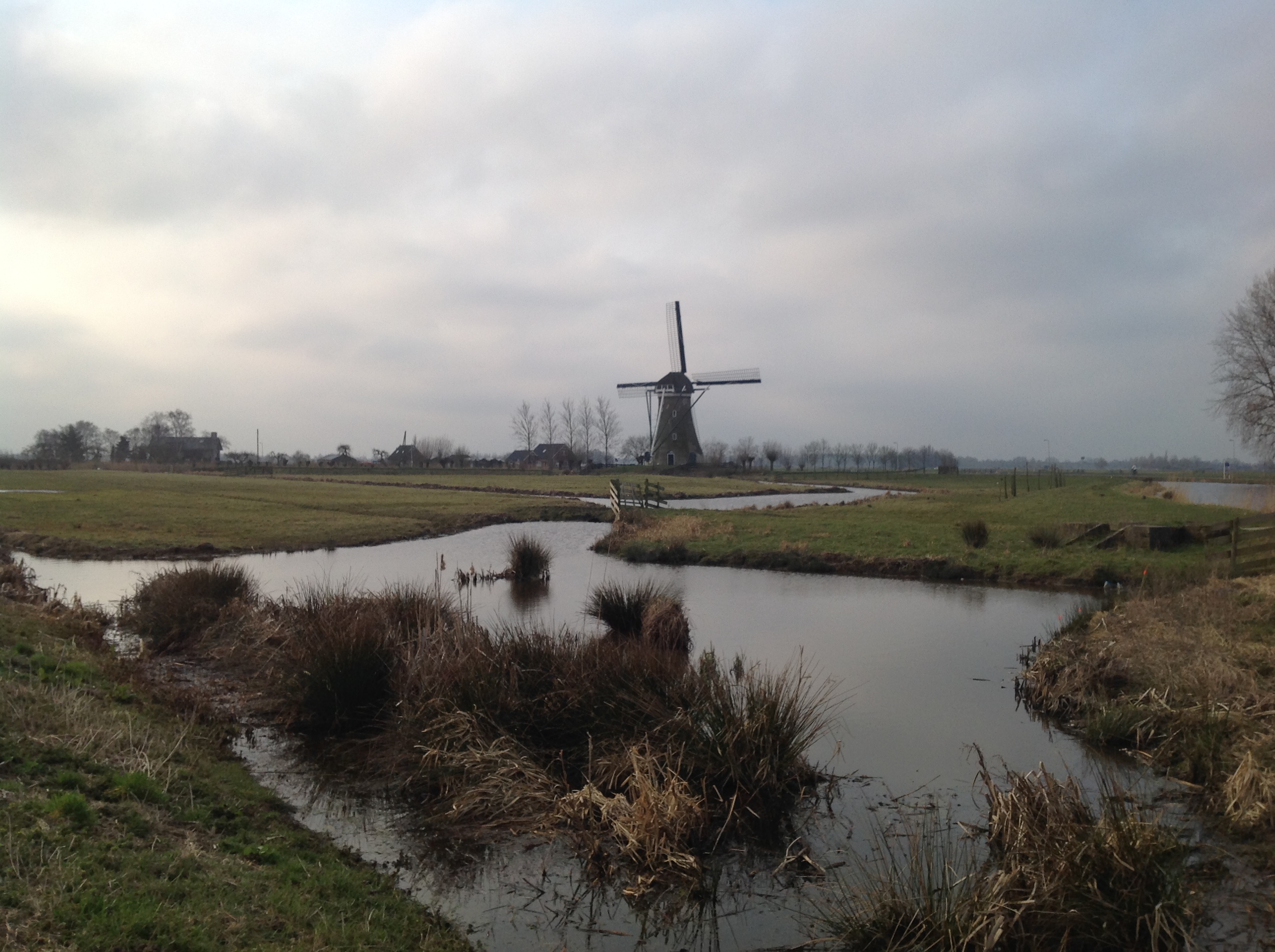
dutch landscape
Natural area, Gouda, The Netherlands

Unlike a crowded museum, nature gives you the time and space to breathe in the art of a landscape, the patterns in a waterfall or leaf, the play of light and shadow mixed with wind, sunshine or an overcast sky. Add in the senses of smell, hearing and touch, and you are in the world’s most intense gallery.

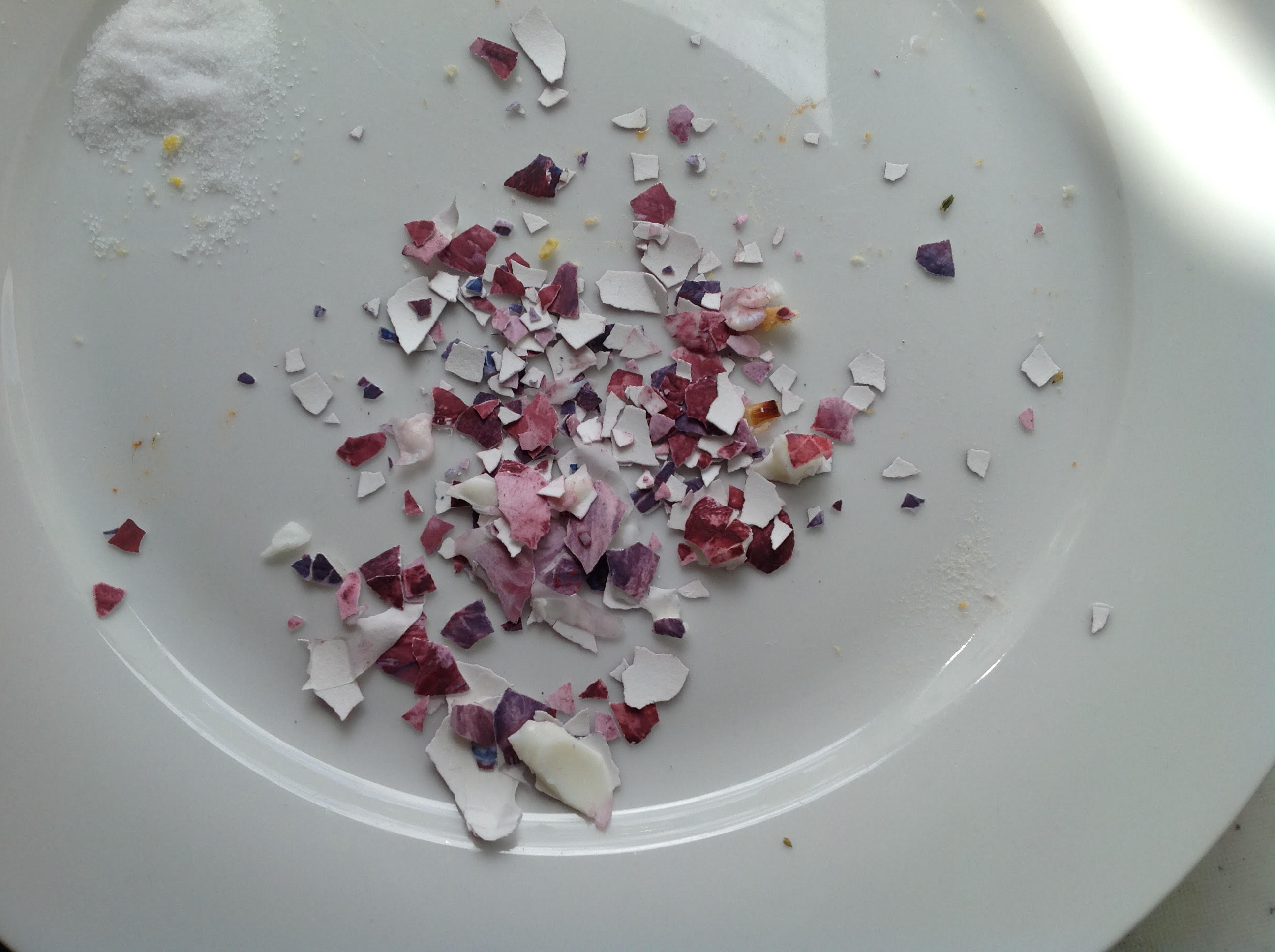
This morning I saw art where no easter egg shellsone else did; in the discarded shells of a colored easter egg. It conjured up memories of Fiesta in Santa Barbara and the confetti-filled eggs for sale at every corner; childhood memories of sitting through a Catholic mass with the anticipation of the Easter Bunny visiting our garden; a Martha Stewart color scheme for an Easter dinner.

Perhaps someone could read my fortune into this particular spread of egg shells: Although you frequently misplace your keys, you are a keen observer; you see art and joy where others see only discarded things. Your Lucky number is 173.

Had it been any other time of year, the discarded egg shells would have offered up a monochrome pallette of white or brown, and I wouldn’t have given them a second thought. Easter transformed the ordinary.

Get your Green on April 18th, 2015 with Earth Day The Netherlands, Bezuidenhout Style


Are you interested in making some changes in your life to lessen your impact on the environment, but aren’t sure where to start? Do you live in The Hague area and wonder what sort of environmental non-profit organizations (stichtingen) are out there and what it is that they do? Do you want to learn about the environment and meet others interested in sustainable living? Do you like festival-like events with music, organic food, eco-shopping and hands-on activities all in a social and educational atmosphere?

If you thought “yes,” or even “maybe” to any of the above questions, then come to Earth Day The Netherlands 2015. This one-day event will bring the International Earth Day concept to The Hague, giving Dutch and Internationals alike a chance to celebrate Earth Day and take action for the earth. Planning on coming? Let us know on Facebook by registering for the event here.

What: Earth Day The Netherlands (The Hague, Bezuidenhout)
When: Saturday, April 18th, 2015
Time: 11:00-15:00
Location: Meeting Rooms at Christus Triumfatorkerk
Juliana van Stolberglaan 154, 2595 CL, The Hague
Why come? To learn about the environment in a fun, festival-like setting.
Admission: Free

Earth Day Netherlands 2015 is shaping up to be a wonderful event. Who is welcome? Anyone interested in learning more about the environment! This event is for people who live in the Bezuidenhout neighborhood, but also for people who live anywhere in the Netherlands interested in connecting with others about sustainable living and action.
Here is a partial list of organizations participating. Information on musicians, eco-vendors and speakers will be provided in upcoming posts. Please SHARE this post on your blog, on your Facebook page, on twitter, etc. Thank you!

Eco Non-Profits
A rocha Den Haag
Duurzaam Bezuidenhout
Duurzaam Den Haag Haagse Krach Karavaan Project
FAIR TRADE CTK
Oiko Credit 
Repair Café Den Haag
Sea First Foundation