I was considering joining a course offered through the church where I work called Werk en Balans (Work and Balance). Guest speakers from professional job coaches, successful businessman-gone-minister, psychologists and others would be giving lectures on seeking this coveted balance.
Seeing as my residence is attached to my workplace, you can imagine that I struggle with keeping my personal life and work life in proper balance. It seemed that the course might have been designed just for my situation. Except that it wasn’t. And it was in Dutch. And it was offered at my place of work. And I’m probably too busy to take on a course right now. But on the other hand, it could be interesting. And, it would push me out of the simple Dutch I use every day and into a language level needed for discussing deeper concepts. I state the obvious when I say my earnest interest was mixed with a healthy dose of reservations. Thus I did what I always do when I’m on the fence about something–talk about it.
I shared my thoughts with the course organizer, expecting some sort of discussion, but her rather curt response surprised me; “Well, you can always take it next year.”
That wasn’t the response I expected at all. I expected her to give me reasons why I should take it, encouragement even. Or, seeing as she is someone I interact with on a weekly basis, to perhaps confirm my suspicion that the course may be too difficult for my current level of Dutch. “You can always take it next year” seemed like being un-invited. Was this the case, or was I experiencing the subtle differences between Dutch and American communication styles? I decided to investigate.
The Dutch like to go for long walks. So the next time I was out with a Dutch friend walking from one small town to the next, I shared the scenario and asked if she thought I was being uninvited.
“Absolutely not,” my friend assured me. “The last thing a Dutch person wants to do is push someone into something, or try to change their mind. Because if I convince you to do something you expressed reservations about, then I suddenly become responsible for your happiness. We don’t like to put ourselves in that situation. We figure you know what is best for you, and we usually leave it at that.” Strange thing is, my husband had given a similar account of the Dutch perspective.
The conversation went further. I admitted that I was used to friends debating with me about an idea and even pushing a bit. You know, responses like this:
It will be a good challenge for you. Just try it. It couldn’t hurt. Perhaps you’re meant to take the course. Oh, come on. Live a little. Yeah. You’re busy, but you always ask a busy person when you want to get things done (is this backwards compliment just an excuse to guilt an already busy person into another responsibility?)
When I shared these types of responses with my friend, she became animated.
“A Dutch person would never say those sort of things. Those are definitely very American responses that would make many Dutch people uncomfortable.”
When I signed up for the course, I was warmly welcomed–well, as warm as a Dutch welcome gets on native soil. And the course did challenge and excite me. And I was too busy, but I did it anyway, and enjoyed the three out of four lectures I was able to attend. As you can see, it was I who convinced me in the end, using all the tactical methods to which I am culturally accustomed as an American.
Have you ever talked to a kid who has never heard of The Red Hot Chili Peppers or The Beatles for that matter? You look at the kid as if maybe all is not right between those little ears and wonder how their exposure could be so incredibly narrow. Last week I had to look in the mirror at the space between my own ears to ask myself a similar question; how on earth did I miss out on the 2006 film Once? Or the lead actors/musicians Glen Hansard and Marketa Iglorva for that matter?
Although Once was produced in 2006 on a meager budget of $160,000, and didn’t really hit the streets running until 2007, it is far from a hidden Indy treasure. It won a 2008 Oscar for best original song, for God’s sake!
Once is the type of film that slowly opens your heart to the character’s struggles and leads you to a renewed sense of hope. Set in Dublin, the film is about an Irish busker who meets a Czech immigrant. Although he plays great covers, she notices and appreciates his original songs. She is also a musician, and as a friendship and potential romance grows between them, they set out to record his works.
As a musician who has been enmeshed in the beauty of creating music with others, I was completely drawn to both Glen Hansard and Marketa Iglorva’s musical performances. Although the Oscar award winning track “Falling Slowly” was fantastic, I found myself on youtube more than once listening to “When Your Mind’s Made up.” Even though the lyrics are repetitive, the song drives me into a frenzy of creative energy. I find myself turning up the volume, my own energy surging as the song builds into a crescendo of the main chorus. A day later, I heard the same song down the hall emanating from my husband’s office. Clearly I wasn’t the only one taken with the music in our household.
You know you are doing something you love when you lose all sense of time. Jamming with other musicians is such a world and Once captures the essence of this experience on more than one occasion.
After watching the movie, I wanted to know if these two characters had lives outside the film and boy was I surprised to learn that Glen Hansard and Marketa Iglorva had a band together called The Swell Season. And on top of that, they were indeed a couple after making the film.
Upon reading this, I felt some great sense of victory, as if a heart warming fictional story had spilled over into reality. But I did not get to cherish this real love story for long, as further reading divulged that the relationship ended a few years later. Yet the friendship remained, as they continued to play music together.
And of course Glen Hansard isn’t just some unknown musician who was hired to do a movie. He is the founder of a famous Irish Rock Band called The Frames. He’s played all over the world, as a matter of fact.
If you feel like receiving bittersweet inspiration, then check out this film and the musicians!
Although this post is mainly about the sun, I must first take a little trip down memory lane: On December 31st, 2010 we arrived in the Netherlands to the surreal experience of Dutch New Years on jetlag–every man, woman and child for himself launching legal and illegal fireworks into the air, the neighbors, nearby automobiles; people of all ages standing on their stoops til 2 or 3am entangled in the general chaos and liveliness. Late the following afternoon we emerged from the tumble of sleeping bags on my in-laws dining room floor, and rubbed our eyes into the new year.
Aware of our Southern California orientation to sunshine, my mother-in-law smartly suggested a walk in the park to catch a few rays before the short day was over. I had to snicker when I saw people bundled up on the benches with their eyes closed, faces tipped upward, as if willing the sun to stay a little longer. How sad for you all, I thought, thinking of the brilliant, unstoppable sun I had seen just the day before as we had left Santa Barbara.
Fast forward fifteen months to mid March, 2012 and I know that these people with their faces raised toward the sun are my people. We head out when the first sunray breaks through the blanket of fog to soak in the light.
All those layers and gloves and hats and scarves and thick socks and boots just for a few minutes of sunshine? Why all the fuss?
According to Sunshinevitamin.org, we make 90 percent of our vitamin D by exposing our skin to sunlight. And what’s the big deal about Vitamin D? Sufficient intake of Vitamin D actually reduces the risk of cancer, osteoporosis, heart disease and helps us maintain higher levels of Serotonin–you know, that happy drug that keeps SAD (Seasonal Affective Disorder) away. Dang! So when I found myself on a bench in the park this winter in my three quarter length coat, eyes closed, face tipped toward the sky, I was self-prescribing in a good way.
But I’m still green when it comes to coercing the weather to evolve into something that more appropriately resembles spring or summer. These hardcore seasonal activists are unofficially referred to as zomerafdwingers, or summer enforcers. Arie Jan overheard this term in a cafe in Amsterdam a few weeks ago. A couple observed some people sitting on the patio when it was far to cold be sitting outside. “Zij zijn zomerafdwingers,” they concluded.
Zomerafdwingers are ruthless when it comes to their job. Nevermind that it’s freezing cold outside. They ask for the patio seating because the sun is shining. Forget that the canals are only halfway through the thaw. It’s mid February and by God, they shall wear stockings with a mini skirt and heels under their winter coats. The wind is howling through the naked forest on a single digit day, but the sun is out. And there goes another zomerafdwinger running in a t-shirt and shorts.
Perhaps this practice is a form of Dutch black magic as it seems to be working. It was warm enough today to sit in our garden and sip on a home made latte. And there in that tepid sunshine, I saw our first tulip in bloom.
Tonight, I joined Arie Jan on the couch to watch the 8:00 news to catch up on world events. Something serious must be going on inside Holland, I thought, as there on the screen was a somber looking Dutch man speaking before an expansive collection of brightly colored microphones. His countenance, continuously lit up by flashes of light, suggested there were more reporters at this live news conference then there are Stroopwafels in Holland.
Had there been an international attack I had somehow missed out on? Or maybe Holland was pulling out of the European Union? Was Queen Beatrix okay? Was Holland sinking into the ocean at a faster rate than earlier calculated, putting us all in imminent danger? I tried to connect the gravity of the image before me with the weathery words I was picking up: lakes, water, ice, snow, freezing point, centimeters, volunteers, ice thaw.
“Oh My God,” I said to Arie Jan. “Is all of this about whether or not that big skating event will go forward?”
“I’m afraid so,” Arie Jan said. “The Dutch take their skating very seriously. Either that, or there’s not much going on in the world.”
Well, in the world of skating, Elfstedentocht is a big deal. It is described as the world’s largest speed skating competition, going through eleven cities and traversing close to 200 kilometers. And, it is only possible if the weather conditions are just right–e.g. if enough rivers and lakes and waterways that form a contiguous skating path through the eleven cities have reached a deep enough freeze.
Thus, it requires the cooperation of not only thousands of volunteers, but of mother nature herself providing the right conditions and the Elfstedentocht commission verifying that the conditions are suitable. And sadly, despite the one day of snow we had last week, and despite all of the Dutch already out there skating on every patch of frozen water they can find, the conditions were not yet up to par for the world’s largest speed skating competition to go forward.
But after 15 more minutes of continuous news coverage, I switched to BBC without too much flinching on my husband’s part to discover that indeed, the rest of the world was still out there, covering stories that had very little to do with speeding across the ice.
If you are Dutch and you are reading this right now, then my apologies to the insult I am bringing on your motherland. But really, 15 minutes of prime time news coverage for live footage on whether or not the 11 city skating event will go forward? These are the moments when living in Holland feels more like being a member of a provincial town where all eyes turn inward toward the upcoming parade or pageant, than an internationally renowned country that influenced far-reaching parts of the world through its seafaring, trading and business practices.
Now, if I only knew an elfstedentocht economist who could explain the monetary benefits of 200 kilometers of speed skating, or a sociologist or historian who could enlighten me on how this race is connected to the sinew that binds together the Dutch national spirit, then I might just see that elfstedentocht is not only plausibly linked to the origins of Dutch worldliness, but does indeed warrant 15 minutes of prime time.
As you were perhaps paging through a Martha Stewart magazine mid November for a little inspiration on a Thanksgiving centerpiece or savory side dish, we were gearing up for the steamboat arrival of Sinterklaas and his zwarte piet collective.
Sinterklaas with two of his zwarte Piet helpers
As you were unfortunately pulling another late night at the office to meet that pre-holiday deadline, we were singing Sinterklaas liedjes in front of our son’s carrot filled boot. As you were contemplating the strange mix of joy, dread, love and chaos that is Thanksgiving, we were watching our son run to his boot to discover yet another present therein.
And finally, as you were regretting that last serving of sweet potatoes with marshmallow topping, suddenly aware of how damned hot you were in your autumn-hued sweater, pushing your chair away from the table, I was asleep. In a different time zone. In a different country. Forgetting all about Thanksgiving.
How can an American forget about Thanksgiving? After all, it is a long standing tradition that ties back to our country’s origins when we broke bread with the Natives, accepted their food, and gave thanks. (Of course we’ll leave out the part where not long after we forgot the being thankful part and killed off the majority of the very natives who’d helped us through that long winter.)
And on an emotional, experiental level, wouldn’t those mostly pleasant memories of family gatherings, happy meals (before the term was co-opted by McDonalds), and those long, post meal walks and conversations in the crisp evening air pull at my heart strings no matter where I now roam?
Yet no strings were plucked. It wasn’t like I was completely clueless or had forgotten about my family. I had spoken to my mom earlier in the week and heard how one brother was heading North to the Bay Area with his family for Thanksgiving, the other brother heading North East to be with his in-laws and how mom was looking forward to the peace and quiet without having to cook anything for anyone.
On the other hand, maybe my subconscious mind decided to just skip that day. Afterall, it was impossible for me to drive on over and spend Thanksgiving with my family, and the few articles I had recently read about the holiday had been less than compelling.
In the Huffington Post, I came across an article about the millions of cramped turkeys strung out on antibiotics awaiting the slaughter, and in the Los Angeles Times, I read some charming articles about how big name retailers moved Black Friday up to Thanksgiving evening–this time the slaughter being of sacred time to gather with family and friends in a celebration for what we already have.
But I have yet another explanation; In Holland ben ik al een beetje gewend. In other words, I’m getting a little used to it here. And a big part of getting used to a new culture is letting go, een beetje, of your own. Rather than letting one’s soul stretch its amazingly long and flexible legs across two continents, causing uncomfortable cramps in the soul’s calf muscle region, it is better to exist where you are. Or, as the songs goes, Love the One Your With. And just as with America, I am developing my own love-hate relationship with my be-here-now homeland away from home.
Being in the here and now, I must report the Sinterklaas madness! I thought Americans went over the top, but Sinterklaas gives Santa Claus a run for his presents. Kids can start putting their boots out by the fireplace, or the radiator should you be lacking a fireplace, as early as mid November and Sint comes to visit on and off all the way to December 5th. If Sint is particularly generous, that could mean 20 days of gift getting! You can imagine the kids are just a little worked up. And, Sinterklaas isn’t some secondary character. He’s everywhere! On the news. On the radio. He even has his own Sinterklaas website. But what really blows me away is what is happening at the schools across Holland.
Ezra was instructed to bring his boot to school this last Thursday because Sinterklaas and his Zwarte Piets were coming to visit that evening. I was just as curious as Ezra Friday morning, and we arrived earlier than usual. As we approached the school yard, we heard the chaos of 150 kids chanting various Sinterklaas songs, running, screaming, jumping and squirming. When the doors were opened, the children pushed their way in, in what could be likened to Black Friday foment, to get to their boots. Although the hallways were lit, the lights to the classrooms were out, and the teachers stood outside the classroom doors like happy wardens, waiting until all of the students had arrived before letting anyone in.
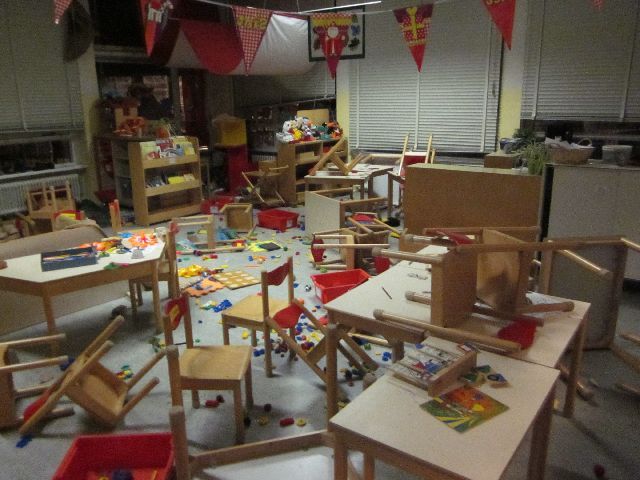
When the door was opened the expectant children surged forth into the biggest mess I have ever personally witnessed: tables were thrown on their sides, toys strewn throughout the classroom, black greasy handprints on the walls. The place was trashed. As I stared in shock, the only slightly phased children climbed over the mess toward their boots on the windowsill, their eyes on the prize. But the boots were empty. And although an empty boot is possible over this 20 day span–Sint can’t go to every house every night afterall–empty boots on such a joyous, expectant occasion can suggest only one thing: naughty, undeserving children. Ezra and I must have come to the same conclusion, as I saw that pre-howl look sweep across his face.
But just then, the teacher happened to notice a note from Rommel Piet taped to a still erect bookcase. It informed the children that he had been to visit and that after the children cleaned everything up, each and every one of them would receive a present. If you haven’t guessed already, Rommel means mess. Wat een rommel, as in, what a mess!
Rommel Piet Pays a Visit to the Classroom
The children reacted in many ways. Some continued to look on with consternation (Ezra), others jumped in and started cleaning up, others spontaneously broke into play. The parents were the last to join in, but after 20 minutes, every last chair was sitting upright and every last Lego, flash card and building block was put away.
Moral of the story? The children had to earn their present. They had to wade through the chaos, do their part to pitch in, and when everyone had helped to make it right, they would all be rewarded. In retrospect, as I made the uncanny connection that it was Black Friday on the westerly part of the Atlantic pond, it seemed that Rommel Piet was some sort of deep, brooding metaphor for the consumeristic state of my home country and the absurdity of Black Friday, or is that Dark Thursday?
Of course Sinterklaas brings his own breed of consumerism, as presents must be purchased, and Sint-specific treats such as pepernoten, chocolate letters and many other sugary goods are almost compulsory items for the shopping cart. But I am nonetheless smitten with the experience and the utter joy that the Sinterklaas season is bringing for our little boy. I do realize we are walking a fine line; on one side is over indulgence and blatant consumerism, and on the other, a cultural experience that nurtures the imaginations of its young citizens. But please, don’t share this latter sentiment with the producers of those chocolate letters.
When a friend recently shared that she had lost her father 10 months ago, my tears surged so quickly that my tear ducts ached. After listening quietly, I shared that I had gone through this as well. I could feel a shift, as if she knew she was not just experiencing that uncomfortable pity that we sometimes unintentionally cast on others; she felt my empathy. She suggested that it would get easier over time, but I told her not to hold her breath. That even a decade later, the pain can still be there.
I lost my father 14 years ago to Amyotrophic lateral sclerosis (ALS), an incurable neuromuscular disease. And even though 14 years may seem like a long time ago, it is only now that I can even bear to write about it. It is true that as time passes, the pain dulls. But the experience of him can come back instantly through simple and unexpected ways; the smell of Old Spice cologne on a passerby, a sudden memory of him sitting in his chair reading the paper, the way he used to laugh so hard that tears would come to his eyes.
If someone famous dies from a rare disease, they may receive the honor, or burden, of having that disease named after them. Although my father had his own rite of fame in the eyes of his friends and family, I am thankful that ALs is not called Bob Anderson disease. ALS is, however, known as Lou Gehrig’s disease, after the famous New York Yankees baseball player whose rapid rise to fame was tragically cut short by ALS. Lou Gehrig and my father had something much more uplifting in common: both of their family’s loved them.
Although we are trained to subdue our emotions and to get over our losses, I think it is healthy to be able to connect with the feeling of loss, wether ten months or twenty years have passed. Such feelings confirm your ability to truly love other human beings, and prove that love is indeed infinite. If I hadn’t cared for my father, perhaps it would be different. But to this day, I believe my father to have been one of the best in the world: kind, patient, humble, great sense of humor, able to give a concise summary of world events, manly enough to say he loved you.
If he were here today, I can only imagine how differently my life might have turned out. I can see him playing with his new grandchildren that have been born since his passing. I can picture him talking with my husband, his hands clasped gently together as he listens. I can imagine him sitting with my mom on the front porch, looking at the play of light and shadow on the mountains in the distance.
Yet I do know that he is here. Over the years I have felt his presence in subtle, scientifically unprovable ways that have provided kindling and flame to my faith in the hereafter. Sometimes when I pray, I picture my father as one of the bearded men up there who may have an ear more keenly turned to my needs. Sometimes those prayers are even answered. So if you think your duties as a father end when your kid turns 18, think again. Once a father, eternally a father.
I spoke to my sister-in-law in America last night and she reported having just thought of me while flipping through a sportswear catalog. Among the image laden pages of must-haves was a pair of sleek thermal running pants for extreme climates. She figured I was probably in need of such an item, poor thing, in the miserable weather of Holland. Yet, to her surprise and my pleasure, I reported that we’ve made two trips to the beach this week, and I most likely won’t be needing any such running pants until at least Wednesday, when the weather is supposed to take a turn for the worse.
Den Haag is a 20 minute bicycle ride from the North Sea. The coastline stretches in both directions with kilometers of open beachfront, some just off the well trodden paths of beach towns and others via walking or cycling-only access through the sand dunes.
Every spring, a whole village of beachfront restaurants are erected along the shore for the summer season, and then deconstructed by the end of the season. These are not wheel-away-at-night patat (french fries) stands, but full-fledged restaurants with decks, glassed in walls, padded furniture, roofs, electricity, thematic designs and palpable sound systems to fine tune an ambiance that differentiates it from the neighboring restaurant. These are not only labor intensive to set up, but the restaurateurs pay hefty fees to rent the beachfront.
The summer weather in Holland was so bad this year that most Dutch claim the season was skipped in this country. The city of Scheveningen must have felt sorry for their beach renters, a Dutch friend informed me, as they extended the restaurant leases until the end of October. And what a good decision it was; last weekend every restaurant was busy and every square meter of beach occupied by a broad spectrum of humans ranging from pale white to foreign-vacation tanned.
I walked with two new friends I had met in a yoga/meditation course and the shore of the North sea on a warm Saturday afternoon seemed the perfect setting to discuss what we had learned. We had all experienced the value of regularly doing the meditation and breathing techniques, but we also felt annoyed by having to do “one more thing,” regardless of how much it improved our daily lives. As we discussed how our meditations were coming along, we navigated our way through the jellyfish that washed up on shore. Although no longer alive, their amber tentacles moved gracefully to the gentle rhythm of the waves. They did not have the tell-tale blue lines on the round part of their bodies that indicate they are poisonous, but their presence was enough to keep 95% of the population out of the sea.
Although we were equally engaged and participating in the conversation, our eyes were still scanning the ground for jellyfish. Soon we made the prudent decision to walk on the dry sand of the beach, thus allowing our gazes to be more all-encompassing, our thoughts more present for contemplation.
As our gazes lifted upward our conversation did flow more easily. But as we proceeded on our journey, I noticed the beach goers on their towels had somehow transitioned from scantily clad to wholly unclad. As we casually ambled forward through the bobbing penises, sagging breasts and occasional sunburnt child, I was determined to focus on the conversation at hand. But soon, the change in landscape penetrated our thoughts.
As we passed naked families sitting together under the hot sun, my friend shared a conversation she’d had with friends just a few nights before about the vast differences in freedom of conversation between mothers and daughters around the topic of sex. The three of us shared in common having almost never talked to our mothers about sex. On the other hand, one of her friends had reported that mom talked openly to her about her sexual experiences down to which toys she liked for such occasions.
In Holland, land of sexual freedom, legal prostitution and drugs, it makes sense that family views on the topic of sex could be much more liberal. If I had thought about the topic before, I might have naturally come to the same conclusion. .
I sometimes have difficulty with the general zen principle of staying in the moment, but my child is like my zen master. Besides the anticipation of dessert after dinner, he seems to live fully in the moment, engaged in play, in laughter, in taking in the opportunities around him. When with him, I too am in the moment. Yes, I can digress back into history and think of holding him as an infant, or think in a general sense about his future educational needs, but for the most part, I think of him as a four and a half year old, no younger, no older. But, former topic at hand, how will this country of liberal indifference influence his sexual upbringing? Of course, parents play a large role, but contemporary society also holds a powerful set of cards in how our children will think. But, keeping my little zen boy in mind, I’ll cross that bridge when I get there.
Sitting on a raised basement, our living room is positioned a half story above street level. This provides us with a tree lined view of the urban bike paths, street and busy tram lines just high enough to be seen by passersby, and just low enough that the branches don’t obscure our view. The first few months of living here I was acutely aware of the people outside, suffering from the strange sensation of being on display. But with the passage of time, that perception has changed. Much like a person living next to a playground no longer notices the playful screams and laughter of children at recess time, now I hardly notice the people outside. Unless the patterns change.
One Monday afternoon as I stood in the living room, my eyes were suddenly pulled outside. No longer was there the languid movement of people going about their business, but a sudden cluster of dark-haired teenagers along the tram line. They pressed in against the metal guard rail as they surrounded two young girls gesticulating wildly toward one another. Soon a cat fight broke out. For a good three seconds, the situation felt humorous, in that uncomfortable, sitcom sort of way as the girls started pushing one another and pulling hair. But as the crowd of 20 or so teenagers got sucked into the burst of violent energy the fight quickly escalated. Fists flew, other students got involved and within 10 seconds one girl lost her balance, falling to the hard cement. Other kids began kicking.
I quickly unlocked the glass door, stepped out on the balcony and shouted in a deep guttural voice “Stop now! Or I’ll call the police!” I clapped my hands loudly to emphasize the seriousness of my words. The teenagers fled like rats from a cat, running off in multiple directions. Several quickly turned to see me and my husband, who was now beside me, and just as quckly turned away, as if afraid we were memorizing the contours of their round young faces for a police report.
It wasn’t the first time I’d witnessed a crowd-induced fight. Nor was it the first time I’d found myself suddenly yelling into a crowd. My first trip to Italy over a decade ago provided for just such an occasion.
My traveling partner and I arrived late one July evening in the Rome Train Station to discover that the strike that had delayed us several hours in Napoli was also in full swing in this station. Blurry eyed with heavy packs on our backs, we didn’t look forward to the prospect of finding a hotel past midnight in peak tourist season. But then a stocky middle-aged Italian woman approached us.
“Need a hotel tonight?” We’d become quite used to such forward solicitations from the Italians, but knew to keep our guard up in Rome. Or at least I did.
“Yeah. How much?” my travel mate said. Seriously? Wouldn’t it be safer to find something on our own? I thought. In a less seedy part of town? While I was doing my best to convey these thoughts through a series of eyebrow contortions, he made a deal and we started following her out of the train station. But just then, my eye caught a break in the pattern.
A fight broke out not 20 feet from where we stood. A group of lanky young Italians started attacking a dodgy looking man in his thirties. A metal luggage cart was lifted in the air and came crashing down on his head. I’d learned a few words in Italian and suddenly I found myself shouting:
“Polizia! Polizia!” The police came quickly and broke up the fight. I wondered if it was too late, as an impressive pool of blood was already forming beneath the motionless man, staining the marble floor of the train station. The woman who we continued to follow out of the station told us that it would have been fine if this man had been killed as he was a known drug dealer. Great, I’m headed back to a hotel with a woman who knows the squalid underbelly of this ancient city and condones vigilante style murder.
If Wikipedia were seeking a photo of seedy, this hotel would not disappoint. When I complained that the shared bathroom and shower was too dirty to even consider using, the woman called her mother to come mop it up. Mom, hunched and thick, must have been in her late 70s. I wondered if the Italians had an elder abuse hotline, or if this was the way things worked in this part of town. The beds were so awful that we slept on the floor on our sleeping pads. But we survived.
Speaking of survival in the true meaning of the word, I wonder if that man in Rome so many years ago survived and why I was the only person to take action. It was, after all, a hot summer night in peak tourist season with plenty of other people around. Of course I like to think that I helped save this stranger, rather than witnessing his murder.
I’ve heard stories from close friends who have also had these situations; there is someone in their midst, a tragedy unfolding and they are the only ones to respond. I’m not suggesting some sort of moral superiority. I didn’t choose social work or another selfless career. I haven’t received any citizen awards for outstanding public service.
It’s more that I wonder what is it that makes one person break out of her awe-struck gaze at a situation unfolding and take action, and another stay fearfully or apathetically locked in place? Remember, for the first few seconds of witnessing the cat fight by the tram line, I participated as a spectator. But I broke out of that role and took action.
I can think of a few reasons I find my voice in these situations: I grew up with older brothers around and had to hold my own, providing my lungs with lots of training; I was raised with strong Christian ethics to do the right thing; my formative years were spent in a small country town where girls never got hit when they spoke up (at least not in public) and I’ve had the great good fortune of avoiding violent situations. So perhaps someone with a rougher background might say the reason I speak up is that I don’t know any better.
And on the flip side, why do violent actions often stem out of groups? One answer I found is “deindividuation.” Deinidividuation, according to a SouthSource article, is when you lose your sense of self-awareness when in a group. Suddenly, you feel anonymous and no longer individually responsible for your actions, as “everybody’s doing it” and you are just an anonymous member of this anonymous group–thus the potential for acting more boldly, or violently. But if you are in a large group that is witnessing something violent, wouldn’t you boldly protest? I’m not sure if it works in the reverse as well.
The next time I’m in a large group, I will try to keep the concept of deindividuation in mind. But in terms of staying true to who I am, I have to wonder; Now that I’m an official urban dweller with a daily view to the tram lines outside my window, will time wear down my good Samaritan reflexes, if I can call it that, or is this a characteristic that will stay with me to the end? I pray it will be the latter.
Yesterday morning I put on my sweats and raincoat and headed to Den Haagse Bos. As my feet left the pavement and landed on the gravel path leading between the leafy green trees, I inhaled deeply, breathing in the scent of nature. Usually this transition from the built environment to a more natural one creates a sense of calm, as if I’ve left the pressures of modern life behind. But that day, the darkened sky and rain cast the forest in a less friendly light. The birds weren’t singing. There was hardly anyone in sight.
As I walked along the dark paths lined with growing puddles, I thought of Sicko, the Michael Moore documentary we’d watched the night before. We’d only caught the second half, but that was enough to suck us in to the horror of U.S. health insurance coverage. The film showed that health care in France was about 190,000 times better than in the U.S., unless you’re a U.S. senator, that is. How is it that the U.S. can be the richest country in the world (is this still the case, actually?) and still not have universal health care? How is it that over 50 million Americans are uninsured? Why are the prisoners at Guantanamo Bay provided better health coverage than most Americans? The dismal weather seemed appropriate for such a line of thought.
My mind wandered over to my to do list: small things at work, maybe a blog post, trying a recipe out of the Sneaky Chef to get some extra healthy nutrients into my 4-year-old. Suddenly there was a man walking toward me, startling me into the present. There was something about him that made me uneasy. In his mid to late fifties, he had loose gray curls and a haggard look on his unfriendly face. I bristled, suddenly feeling less cozy and thoughtful in this forest I’d come to know, and more aware that I was indeed walking alone in an unpopulated forest in a big city.
A thimble-sized shot of adrenaline coursed through my veins as I walked firmly past him. I didn’t feel fear so much as strength, as if I had tapped into a primal, animalistic response. The type where feathers puff and muscles flex; a don’t-fuck-with-me sign in your energetic field. Moments later, a black, mid-sized dog came running down the path, and based on his unkept appearance, I was sure he was with the man.
It happened so quickly I couldn’t make sense of it. Instead of running past me, the black, mangy looking dog attacked, growling as he snapped at my leg. Just as quickly he was gone. So much for my animal instincts. I looked down at my sweat pants to see a gaping hole exposing my white skin. Had it actually bitten me? I peered into the rip to see two little red spots where his teeth had just broken the skin. No blood poured out, but the skin was broken. I called after the man in Dutch.
“Your dog just bit me!” A normal reaction would be for the dog owner to apologize profusely, but this man just ran after his dog, yelling for it to come back. Perhaps he was as shocked as I was.We weren’t nearly as isolated as I imagined, as a couple with a cute, friendly little dog came upon us. They saw the look on my face and slowed their pace. I explained to them what had just happened and they were shocked. Top news story of the day. They stopped and waited with me.
They suggested that the man pay for a new pair of pants. This man, whom I had viewed as a threat a few minutes before, now seemed less scary and more like someone who had been beaten down by life. I had never thought of asking him to buy me a pair of pants. This is a very Dutch way of thinking when it comes to taking responsibility for a wrong doing.
Let’s just say I agreed the man could buy me another pair of sweat pants. Wouldn’t that require exchanging information? Giving him my address to mail a check? They don’t actually use checks here, but wire money directly to your account. Was I supposed to give this stranger, who gave me a bad vibe, my bank account number? At the time, my mind couldn’t grasp onto any of these ideas, and all I wanted to do was to continue on my walk. Yet, I did want one thing from him.
“You can’t let that dog off his leash. He’s clearly dangerous.” He seemed to agree.
By the time I got back home and told Arie Jan what had happened, the idea of rabies and other unknown terrible diseases you can get from an animal bite had made an impressive number of laps through my mind. But Arie Jan–usually my Rock of Gibraltar when it comes to keeping me away from those ruminating thoughts–joined in on the refrain. When was the last time I had a tetanus shot? We need to get you to a doctor.
I usually lead a pretty healthy life, save a dog bite now and again, and thus visiting a Dutch doctor’s office was to be a new experience. Well now. Come to think of it. In light of Michael Moore’s documentary, I had been wondering what the Dutch universal health care system was like.
We called a local doctor’s office and were told to come right over. Because I’m married to a Dutch man, and have my work permit, I am covered under his plan. We hopped on our bicycles and rode through the pouring rain to the office, about 6 minutes away. When we got there, and pulled off our dripping rain coats, we were handed a four page health history form. Ten minutes later, I was whisked into an office. A friendly female doctor looked at my wound and decided a tetanus shot was in order on the premise of better safe than sorry. That was it. No line. No co-pay. No health insurance paperwork. Hopefully I won’t have to revise this story with any ghastly updates about the Dutch health system, but my first experience was, needles aside, rather pleasant.
We mentioned the dog bite incident to two people in church that day–one who is a police volunteer and happens to have a medical hotline programmed into her phone, and a nice Indonesian woman who works in the office, as Arie Jan had to go with me to do the initial paperwork and we needed someone to be on hand for the clients in the church.
But news of my bite spread like rabies. Just about everyone I’ve seen since that bite into consciousness has asked me about my leg. And you know what, sometimes it feels good to know people are talking about you.
While my friends back home in book club are reading The Book Thief by Marcus Zusak, a heady young adult work of fiction about death and other things, I am reading O, O, Olivia, chick lit about a wild, confused young woman in her twenties who has a one night stand. I have a worthy excuse for my literary deviation: education and future success in the Netherlands.
Before you raise your eyebrows and wonder where I’m going with this, O, O, Olivia is in Dutch. And, it takes place in Den Haag. Topics of romance and sex can be strong motivators to dive deeper into a second language, and dive in is what I am doing–260 pages of diving with sentence after sentence of authentic, contemporary, idiom-filled Dutch.
I’m a sucker for well designed grocery store end displays, that section of real estate at the end of the aisle that convinces you to buy something you don’t really need; green olives stuffed with anchovies for example. I am also quite susceptable to strategic chapter breaks–a chapter that ends with something that leaves you curious. Not quite a cliff hanger, but enough of a pull that you rub your weary eyes, glance at the numbers on the clock face and plod ahead anyway. And author Gillian King has that “strategic chapter break” thing down.
Suffice to say she is hot right now. And I’m not the only one staying up late turning the pages: Olivia is on a seven day express loan. If only I could turn the pages a little faster. Problem is, I don’t just have this nice, sexy book with a pink cover (strategically designed to pull my female eye hither to scan it’s cover, read the back cover summary, and put it in the stack of library books), I also have my essential Dutch-English dictionary in hand to help me through.
As I read and get into the flow of the story, certain words start to lock in, expanding my vocabulary. Other words are road blocks, getting in the way of me knowing what else the lead character is doing to screw up her life. But wildly scary words such as zenuwachting (nervous) or ongemakkelijk (uneasy) are skillfully tamed by my Dutch English dictionary.
For those wanton words and expressions that my dictionary is just too dignified to translate, I have Arie Jan. Sure, I’ve picked up words I’ll never be able to use in my work at the church, but they’ll certainly come in handy watching Dutch television, startling my husband or eavesdropping on the ladies talking in conspiratorial tones at the next table during lunch.
Several people have commented over the last few weeks that my Dutch seems to be making leaps and bounds. I smile politely and say thank you. No real need to elaborate that I’ve been motivated by a fictional character having one night stands, out partying in Het Plein and thrashing her otherwise respectable life, and the desire to see if she gets that extremely hot guy in the end.
If you are beginning to grasp a second language and want to experience a sudden jump in understanding, read something in your foreign language of choice that is shamelessly compelling to you, whether it’s about companion plantings for your organic garden or a foreign espionage thriller. What better way to compel yourself forward. And you might be pleasantly surprised like I was; not only am I expanding my vocabulary, I am also discovering that happy endings are possible in other cultural writing as well.

 kristininholland