Are you up for being Human?


A few weeks ago, I went to the Nutshuis in the center of The Hague to watch a documentary called Human  directed by Yann Arthus-Bertrand. This 2015 documentary, presented by Alliance Francaise La Haye (French Alliance of The Hague) explores what it means to be human world wide.

It started out as a festive evening. Rows of wooden chairs draped invitingly with red blankets stood in the garden.  Of the 40 or so people who attended, I personally knew half a dozen and my friend Joanna introduced me to half a dozen more. The glass of wine in my hand, easy conversation and a dark blue sky peppered with clouds created the perfect alchemy for an uplifiting evening.

Before the film started, Françoise Bernard,  the editor and co-director of the film was interviewed by a member of Alliance Francaise La Haye. They sat before the audience and spoke intensively with one another in French. Although I couldn’t understand the details, the few French words I know paired with the cognates that popped out of the dialogue allowed me to vaguely follow the conversation. I understood the words emotion, world, love, planet, poverty, human.

Even though I had watched the trailer and knew full well that I was in for an emotionally heavy evening, my mind shrugged it off, leaving me unprepared for what was to come.

From the very beginning, the film entered me like a bolt of awareness. Within minutes, people in the audience, including myself, were sniffling, blowing their noses and wiping tears away from their eyes. And we were only 10 minutes in. God were we in for a journey.

The people being interviewed on the screen seemed to be having a personal monologue with me, rather than the reporters who interviewed them. The journalists were not shown, nor were their voices heard, resulting in a sort of one-way conversation with the interviewee. Their foreign words, translated into English and presented in white text against a black background, pushed right through whatever natural barriers society might have trained me to erect to protect myself from their emotion.

If a dear friend were to talk to me so directly, I would still be in a frame of mind to listen while formulating a response to share with them; words that would somehow benefit them, offer hope or counsel, or perhaps I would offer silence as a form of support. This interview format was so effective that you could not formulate a response. All you could do was listen and absorb and realize that these total strangers from foreign cultures are undeniably tied directly to you in the very act of being human.

Their fears became my fears: I too was concerned for their children who have no food, their land that had dried up, rendering it useless as a means of sustenance, their struggles with homosexuality in an unforgiving culture or family, their tragic childhood situations. When they shared their definitions of love, happiness and poverty, my definition of these terms expanded through their experience. I felt ultra sensitive to what all of these humans were sharing with me as if they were pleading their case directly to me, and I must answer to them.

Human is overwhelming and of epic proportions. When I say epic, I don’t just mean long (143 minutes), but also in the way it confronts you. The directors must have been aware of this potential effect and taken a bit of pity on their potential viewers. This pity came in the form of breathtaking aerial footage of nature and people: a raging sea, a stretch of salt flats interspersed with blood red earth, children in traditional dress on horseback, galloping across vast high-mountain prairies, boys playing soccer among dirt and rocks on treacherous cliffs . Each scene provided both a reprieve from and a deepening of the monologues yet to come.

When the screen finally went black, I was both relieved and already mourning the end of this beautifully filmed journey into our shared humanity. That couldn’t really be the end. There must be a plan?

I spotted Françoise Bernard, the editor and co-director, surrounded by a small group of people. Even though it had been a long night and we were all a bit tired, I waited patiently until I had a chance to pose my own question.

“You made this wonderful, epic film about being human and the inequities in the world. What is your next step? Are there specific causes you are promoting? Is there a list on the website?”

I expected her to say “Yes, of course. This is just the beginning.” But no. Her answer went something like this.

We thought of selecting different charities or organizations that are addressing these issues, but it was too challenging to choose among them. Rather, the next step is what you can do about it within your own sphere of influence. She might as well have said “Be the change you want to see in the world.” A great slogan, but how do you actualize something like that?

Even though it was quite late, a handful of us needed to process the film and ended up finding a late night cafe to shelter us as we discussed the film together. Although we differed in our opinions about the techniques and length of the film, one thing was certain; we were all overwhelmed by what we had taken in, and shared a common desire to do something about it.

As we discussed our various spheres of influence, we realized that each of us can do something every day to positively effect the lives of others. Most of the people at the table were already activists in one form or another, working on issues of climate change, care for the ocean, nuclear disarmament, education and organizing charity events.

On top of that, a lot of the solutions had to do with money:  choosing Fair Trade or Fair Chain products, putting our money in banks like ASN that only invest in companies that meet their stringent principles, being politically aware and active, reducing our carbon footprint, attending fundraisers for small-scale initiatives both here and abroad where money goes directly to improving the lives of others, helping those within our own lives. The list went on and on.

I wonder how you would react if you were to see the documentary human. Would you feel a need to change the world? Would you believe you could?



Happy 4th and Capitalizing on Captilalism


Happy 4th everyone! That little sentence needs no explanation to my U.S. friends. In fact, I believe 99% of you have the day free for the celebration of U.S. Independence Day, besides Antara, who is helping set up the stage in her town for the big day.

Fourth of July is a national holiday in the States. It is filled with barbeques, parties and fireworks displays put on by the cities. To see where it’s legal to add to air pollution and and torture animals and small children through noise pollution–i.e.set off some fireworks, you can Check out this link for California.

The 4th of July is just another day in The Hague. Thus my Independence Day has been spent behind my work desk: no beer in my hand, pleasant conversation or that fine summer sensation of eagerly awaiting a not dog or corn on the cob fresh off the grill.

But not all is lost. This past Saturday, we were invited to a barbeque at a fellow Expat American’s house here in The Hague, and almost all of my Independence Day needs were met: Kids playing, watermelon, socializing with friends,  a cold beer in my hand, sunshine, a BBQ in the backyard,  a sometimes pessimistic, sometimes uplifting discussion of what Independence means in a post-freedom world of Homeland Security, cyber spying and the  invasion of digital privacy;  the right to bear arms and the consequent accounts of public massacres in schools, bars, movie theaters and workplaces; the concept that corporations are running the country, rather than our government; and the hope that American ideals and values still shine brightly despite it all. If there had just been a fireworks show, I would be sated.

On another American note, I found the start of a post in my saved drafts from last November. I suppose I had a whole rant planned, but got sidetracked. Funny that I should discover this on the 4th of July just as  my work day is over.

Capitalizing on Capitalism (from November 2015)
Something weird happened this past Friday; we opened the pile of advertisements that come in the mail and I discovered something strange among the color catalogs–a little black bag. On the black bag were the words: Black Friday Sale.

Are You Serious? Its bad enough that Friday after Thanksgiving in the United States has turned into “Black Friday”–a frenzy of crazed shoppers storming big box retail stores to get deep discounts on stuff  just hours after sitting down to a meal with family and friends designed as a day for reflection, coming together and giving thanks.

But here in the Netherlands, some crazy marketing person decided it was okay to just skip  the finery of Thanksgiving all together and just capitalize on a distinctly American crazed shopping day. That is the apex of capitalizing on capitalism.

A Glass of Tap Water Please?


In the U.S., receiving a glass of tap water with your meal at a restaurant is about as normal as receiving a fork, knife and spoon with which to eat your food. Restaurants in drought areas don’t bring it automatically, but if you ask for a glass of water, they will bring you one without hesitation. But if you ever want to feel like a subversive, just try ordering a glass of tap water in a Dutch restaurant.

A while ago I met my friend Colleen for lunch at Brocante Brasserie in Pijnnacker.  At 11:45 on a Friday, this cozy restaurant was half full. We started with a cup of tea as we caught up with each other, then placed our lunch order. Before they brought lunch, we were feeling a bit thirsty.

dnews-files-2014-01-glass-water-670-jpg“I wonder if they’ll serve us tap water here,” she asked.

If you’re from the States, that might sound like a strange question. But in The Netherlands, many restaurants refuse to serve tap water, and it has nothing to do with water quality. Dutch tap water is very high-quality and even tastes good. So safety has nothing to do with it. It’s all about money.

If you want water in a restaurant, you have to buy bottled water, which can range from 1,50  to 6 euros, depending on the size and brand. But the reason we were being so anarchist in our thoughts this particular afternoon was that we had both heard talk of a new law that restaurants can not deny you a glass of tap water.

So, we ordered tap water and the waitress launched into a monologue about how they don’t serve tap water. We mentioned the new law and she still refused. When we shared our concerns, she said she would get the manager. He repeated the same speel as she did. No, they do not serve tap water. He would be happy to serve us a bottled water, but there would be no tap water. He was young, rude and unwavering in his stance.

If I wasn’t looking forward to our lunch together, I might have been tempted to walk out. Water is as necessary to our survival as breathing and no one should deny you access to something as basic as municipal water–which we all financially contribute to maintain through taxes here in the Netherlands. Further, with all the manufacturing costs, transport and associated environmental pollution, bottled water is a crime against the environment.

My friend and I weren’t alone in our thoughts on this. In fact, a petition called “overall kraanwater graag” (tap water everywhere please), has gathered  107,075 signatures and counting to make tap water available everywhere and stop restaurants from denying us this basic need. To be fair, I wouldn’t mind paying a nominal fee for tap water, considering the waiter has to serve the water, the glasses need to be washed, etc. But denying me tap water all together seems just plain old wrong.

So I signed the petition. If you live in the Netherlands, feel free to sign it too.

Since that fateful lunch, I’ve been asking for tap water every time I go to a restaurant and have not been denied since my Brocante Brasserie Pijnnacker experience. In fact, my friend and I decided to go to another restaurant for dessert that same day and guess what? They served us tap water without batting an eye. Wish I’d remembered the name of that restaurant for the tap water map.

The what? Well, let me explain. I received an email at the beginning of June with the following call to action: This summer, dare to ask for tap water at your favorite festival, bar, restaurant or beach tent ( a seasonal restaurant set up on the beach). If they give you tap water, then take a “tap water selfie” and place it on the tap water map, which can be found at kraanwaterkaart.nl.

How cool is that? In addition to giving attention to a restaurant that gets this basic concept, you have a chance of having a ‘kraanwater locatie’ named after you.

Interesting articles related to the bottled water debate:

The Telegraaf: Horeca moet gratis kaanwater schenken, March 23, 2013

Refinery 29.com article, December 7, 2015


A Shot of Memory


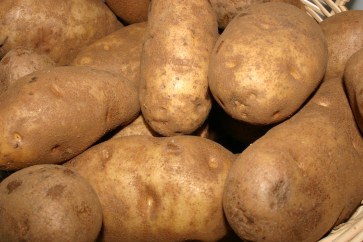
This morning I poured myself a half cup of coffee and sat behind the computer to begin work. With my first sip of coffee, a shot of memory tore through me.  I was catapulted back to one summer in the early 1990s in Rupert, Idaho. I stood inside a scale house weighing 18-wheelers before and after they unloaded potatoes into a cooled warehouse.

I could picture the wooden structure of the weigh house, the giant ground scale that the massive trucks would drive onto, the green paint (was it green?). I could clearly recall the characters who drove truck for a living, remember the nosy questions of my co-worker, the playwright boyfriend I had at the time, the dust, the monotonous recording of weights and tares, the pot of coffee blackening on the burner. It was peak harvest season and all of those potatoes had to be delivered into a cool, dark place–a race against nature that lasted weeks. Like all of the other seasonal harvest workers, I was putting in long hours and earning double wages in overtime–which amounted to quite an exciting sum for a college student.Russet-Potatoes-morgue

I haven’t thought about that one-time summer job for years. What triggered it? The coffee? I’m fairly certain the Douwe Egberts coffee we brew at my work is of higher quality than what I poured into my veins during those long hours back in Idaho. Perhaps it was the artificial koffie melk creamer I had placed in the coffee. Or the forest green of the porcelain cup from which I drank? The rain? The shifting of gears of a truck rambling by outside? It must have been the perfect storm of sensory input for this memory to appear so acutely.

I wanted to take another sip of coffee, pause the world and explore this forgotten memory. But there was no pause button. Just as quickly as it came, it flittered away, and I was left only with an impression, a sensation from the past. I wish I had a journal from this time. But even if I did, I doubt I would have written my impressions of the scale house.

I have a theory why this particular sip of coffee was such a catalyst; I haven’t been drinking caffeinated coffee for close to three weeks now, and although this was not my first transgression, it was a conscious sip. Drink sparingly and consciously. You never know what might happen.


Drivel of the Privileged


I had one of those woke-up-on-the-wrong-side-of-the-bed days this past Thursday. Things just wouldn’t function. Drawers wouldn’t close properly. My computer was PMSing. A client showed up without a reservation. “Surprise! We’re here!”

When I got home at 6:30pm, I was ready to put the day behind me. That’s when I noticed; my sweater was inside out. Yes. I had worn my sweater inside out the entire day and no one had bothered to tell me.

Of course all of the people with whom I corresponded didn’t see it. And granted, I did have my jacket on over my sweater for the first half of the day. But the second half . . . did they really not notice those seams sticking up on my shoulders? The washing instructions tag near my right side? That tag on my back? Or were they too embarrassed to tell me?

In retrospect, the day before was great.  The day after  was also a fantastic day–went off without a hitch.

So what is going on with the universe? Do you have to sacrifice a day in order for the others to go swimmingly well? Was my inside-out sweater my sacrificial lamb to the God of Bad Days? And seriously. How bad of a day did I really have? I’m healthy, unscathed. No one I love is in danger. In fact, if I just think about it in terms of the greater world–about what a true bad day means–then this whole post is just the drivel of a privileged individual who has lost perspective.

That didn’t stop me from sharing my sweater story with a fellow work out partner during Cora’s Bootcamp this morning.

“I had my bad day on Friday,” she shared with me. She was working in a new city and was stuck in traffic for an hour and a half. She couldn’t find a parking spot so she parked in a garage. When she got off work, the garage was closed and she couldn’t get her car, or her suitcase. She had to take the train back to her hotel–no change of clothes, no toothbrush. Plus, she had to get up extra early to get to the parking garage.

“Okay. Now that’s a bad day!” I sympathized.

“Well. Not really,” she went on. “Ends up the parking garage was like 18 euro less than the hotel parking. So it was actually a good thing.”

Sleeping in your work shirt and using chewing gum for a toothbrush was a good thing? Now I thought I was an optimist.  The God of Bad Days has no sacrificial lambs or inside-out sweaters needed. It’s all about perspective!

I had to work on my day off, today, and I don’t get paid for over time. I’m sure there’s something good in there. I just need a little more time to think it through.

Crazy Man, Art and Happiness Jars


Kat, an old roommate of mine who is an adult with A.D.D. once explained what every day was like for her. She hears and notices everything –each sound amplified and recorded in her mind, demanding equal attention. Her life is rich with detail, but such richness has a downside.
“It can be overwhelming,” she said.

In my New Year’s quest to be more present and aware of my surroundings, I had a semi-Kat day this past Sunday.

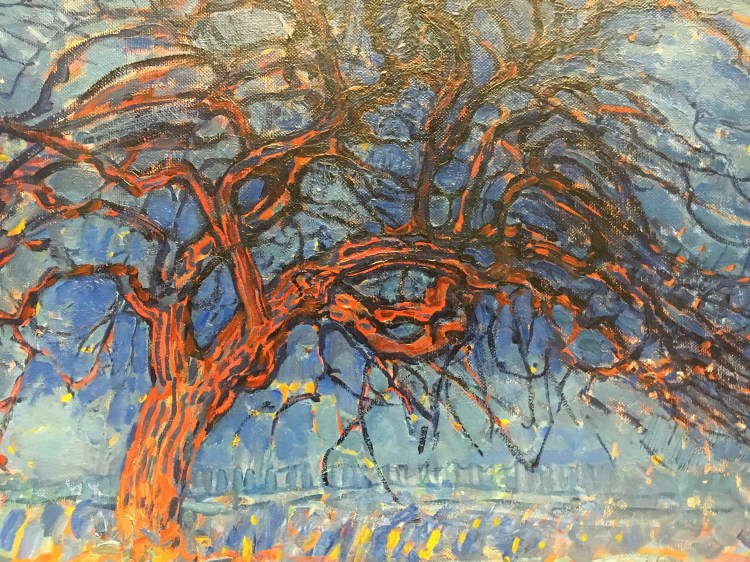
After church, still dressed in our finest, we decided to head to the Gemeente Museum. There is an exhibition called “Mondriaan en de Stijl,” in which two of my favorite Mondriaan’s were on display: The Red Tree and an the Windmill in Sunlight.

IMG_0114
Evening, the Red Tree, by Piet Mondriaan 1908-1910

I stood before these paintings transfixed. I stepped closer to take in the brush strokes. Stepped away to see the whole. Their unnaturally bright hues cracked open the color palette of expectation, and created a jolt in me, as if someone has snuck up and scared me. But instead of fear, the shock that coursed through my body was one of anarchistic excitement. He dared to paint a windmill blood orange and red, a tree crimson with cobalt underlining.

IMG_0111
Windmill in Sunlight by Piet Mondriaan, 1908

I lingered before the paintings, waiting for the shock of excitement to dull within me. My son and husband had moved on to the Museon, an interactive children’s museum attached to the Gemeente Museum by an interior corridor, and I longed to find them, bring them before these paintings and see if they had the same experience. But the museum was closing in half an hour.

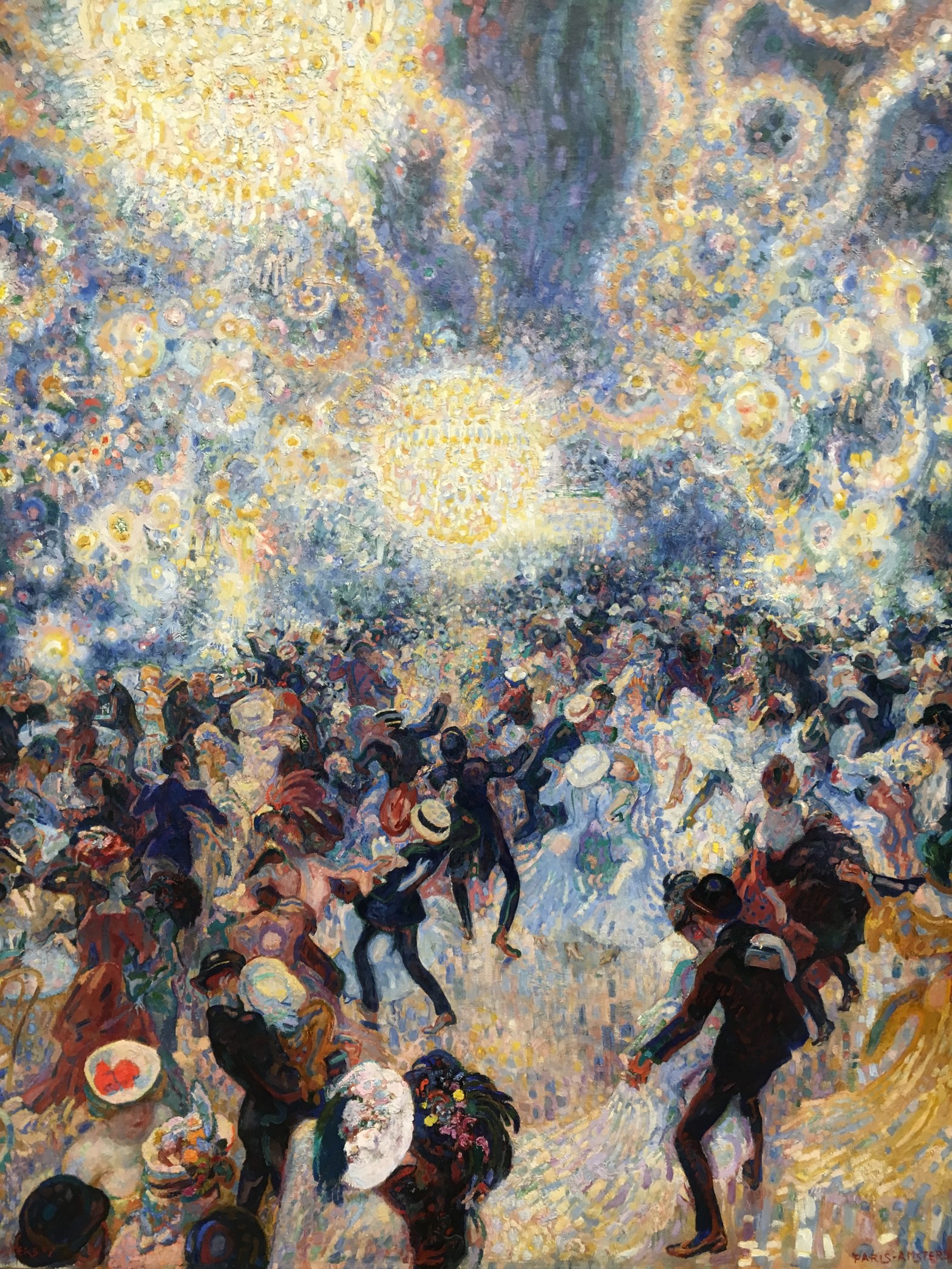
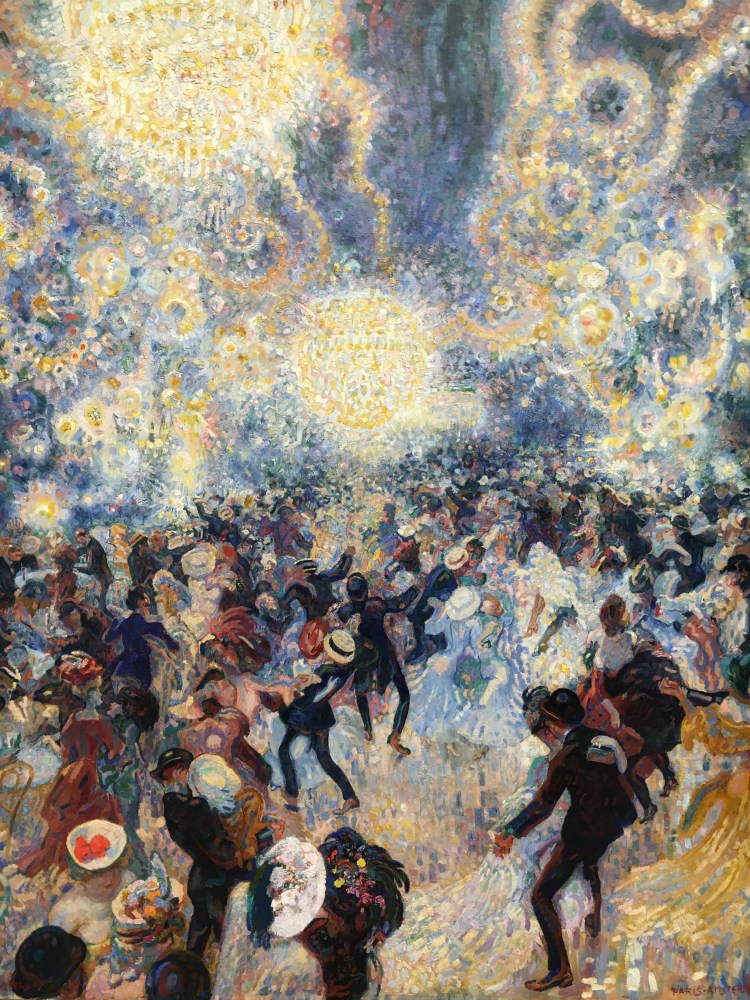
A third painting also pulled me in. Its familiar to me, as if a friend had a poster of it on a wall at some point in my past. In person, it dazzled me in its snapshot of raucous joy; ladies and gentlemen dressed to the nines, dancing beneath the swirling lights–lights so brilliant and abstract that they could be candelabras of the Aurora Borealis interpreted in whites and golds.

IMG_0104
Bal Tabarin by Jan Sluijters, 1907

I realize art is a personal thing and affects us all differently. I mentioned the Sluijters painting to my husband, who had seen it many times, and his shrug-of-the-shoulders indifference grated against my enthusiasm.

The clock struck five. We bundled up in our coats and hats and headed for the tram, waiting with all of the other museum goers who had stayed until closing time. While we waited, we watched an elderly couple step into a silver BMW roadster. The woman drove away carefully.

When the tram arrived, we boarded with the other museum goers, filling up the tram.

“Just be honest with me, damn it! Can I really fly to Indonesia for € 480? Come on, don’t lie to me! I’m sick of all the lying from the telemarketers! You look like you’re from there. A good lie will do too.” His voice boomed from the last car in the tram. People turned toward him, pulled by the loud intrusion of his voice. I glanced too, catching his clear, wild eyes, his dark hair, before looking away. A man in his thirties speaking Dutch with the accent of a foreigner who has somehow come to stay here too long. I didn’t see the person next to him, his current prisoner, as he kept yelling.

“And all those refugees! Giving them food, a place to stay, allowing their homosexuality! What a bunch of bullshit our government! How can we allow it!”

People stopped turning toward him. Even the children on the tram instinctively knew not to make eye contact. We made eye contact with each other instead; strangers glancing toward each other, as if to say, “It’s rather sad, really. Just ignore him. I apologize for the inconvenience.”

He finally got off the tram, and the whole car decompressed, as if we let out a collective breath. The driver came out of his cabin and walked all the way to the back in search of the offending man, but he had already departed. What would an abstract painting of this man and his crazed negativity look like?

In the evening, I suggested an activity for my family: a happiness jar. Each evening, we write down something that made us happy that day and put it in the jar. They both looked at me over the leftovers on our dinner plates in true Dutch fashion: slightly annoyed, yet lackadaisically tolerant.

“I need an unhappy jar, too.” My husband said.

“Yeah. Then I would write I’m unhappy because there’s a happy jar,”my son added, a devilish grin on his face. They laughed together at their own cleverness.  I set  jars before them, cut up an old envelope for pieces of paper, gave them pens. Everyone wrote something and placed it in the jar. I’m not sure if it made them happy or not, but we’ll carry on.


January 1, 2016 Impressions


It started in the early hours of the morning with a round of Pommery champagne as we join strangers on the corner, all gazing skyward at the sparkling, cascading mayhem of gunpowder disguised as fireworks; aware, like someone on a new frontier, that no one is in charge; anything is possible.

Long after our New Year’s party breaks up and we’ve retired to the comfort of our bed and drawn the thick curtains, the fireworks continue. Demonstrating the surprising tenacity and spending power of our neighbors near and far, the crackling, booming and popping continues throughout the witching hours, slowly diminishing in frequency as the early morning light fills the sky.

Oatmeal for breakfast at 11:15am. I am hung over more from firecracker -induced lack of sleep than from the Pommery. Under such circumstances, the sunshine outside lacks its usual appeal. But our Vitamin-D-challenged reality urges us out of the door anyway, and we start walking.

Waiting at The Hague Central Station for Tram 9, we see the return tram arrive across the platform with everyone inside wearing the same bright orange hats. It takes a moment, but my husband and I suddenly get what’s going on.

“Was het koud?” I ask the first of the young men who come off the tram and cross toward us. They nod, proud, pleased with the acknowledgment of what they have done. It will be crowded at the beach, but that doesn’t deter us.

My son asks me why I asked the man if he was cold. I explain that every year on New Year’s day, a lot of Dutch people head to the North Sea for the polar bear swim—meaning that they dive in the ice-cold sea and then come out again. Unox, a company that sells things like canned soup, has apparently monopolized on the situation by giving away a bright orange cap to all who jump in the sea, the lemming of hats. But there are no free hats: each crazy that has jumped into the North sea to jump-start the new year heads off into the city as a walking UNOX advertisement.

We catch the tram and walk to the sand. Our pace is lazy, slow. I take pictures. My son plays in the sand. The sun shines. I feel simple happiness that must be a basic instinct as we walk together.

I remember a photo that’s still in my Facebook from over 10 years ago. One of my husband and I on a beach in Southern California, back when we were first dating, yet unaware that we had found our life partners in each other.

We take a selfie while my son jumps in the background, too short to do a real photo bomb.

Our friends meet us on the beach. They bring a soccer ball and the boys and men jump into action, laughter, yells, running—a burst of energy that seems to be drawn from some sort of male fusion.

I am happy to see my girlfriend. We chat, hug, breathe in the crisp air. She has a belated birthday present for me that gleams in the sunshine when I take it out of the black and white wrapping paper.

We watch a group of fraternity boys heading to the ocean in ties and swimsuits. On their return trip, I ask if I can take a photo. They pose grandly, cheering, their wet chests jutted forward as they shiver in the growing wind so a stranger can take a picture.frat boys Scheveningen 1-1-2016.JPG

Later, at home, we all do our own things. The big one naps, the little one watches a movie, I rewrite the last chapter of my book.

Feeling a mild sense of accomplishment, I go online and see a post from a Syrian refugee I had the honor of meeting during his six weeks in The Hague. I ask him how the new refugee center is where he’s been transferred. He is conscientious in his answer; honest, but not overly critical. I ask if there were fireworks last night.

He says yes, they were nice, but then they reminded him of the war.

Last night, during our party with champagne and conversation about politics, literature, education, we also wondered how the refugees would respond to the fireworks. It was a light conversation. Now it is a hard reality. It reminds them of the war, a war that is still going on.

I look up the town where my refugee friend has been sent and it is not a town at all, but a refugee center surrounded by farmland. They are not allowed to learn. There is nothing for them to do. I don’t get it. I wonder what is wrong with our government. I realize it is complicated, that there are too many refugees all at once for our country to handle in a proper manner.

I try to imagine myself as a problem solver, finding a way to create jobs and a livelihood for the handful of refugees I have come to know in the last six weeks. I am clearly aware that I want to help those I know, even if I’ve only met them a few times. Could we all adopt-a-refugee and together, create a shared economy where everyone benefits? Do such thoughts make me a Marxist? A communist? Do others think like I do?

A friend sends me a text asking if she can take me to a film to belatedly celebrate my birthday. As a close-to Christmas baby, I am used to belated birthday offers. I concur. We set a date. I temporarily forget about my refugee friend on the other side of the country.

It is late, but I skype New Zealand anyway. I talk to my friend for an hour, hearing about his life there, his accomplishments. He asks me if I’ve written another book. I say I have. His eyebrows go up. Perhaps it was just a polite question, but he says, “I had a feeling you had. Is it another romance?”

“Yes.”

“Oh.” His smile is half pity, half amusement.

“But that’s okay with me,” I explain more for myself than for him. “I like writing romance because they bring hope, are about love, and have happy endings. And what I want most in life for people is that they have love and happiness in their lives.”

My words ring true. That would probably be my mission statement if I were a corporation.

I think of Tarek, Julia, of Nidal. Of Majd, Kinda, all the other refugees I have met who have hope in their eyes, despite the war, the terror, fleeing for their lives. Wonder if that hope will still exist in their eyes six months from now, a year from now. What our government will do with them. What we will do, can do, to ease their journey here and aid them in becoming self-sufficient, getting back their dignity.

It’s late. I’m looking forward to reading another chapter of Light Years by James Salter before I go to sleep. I hear the trams running in the night. I hear my son shifting in his sleep. I think of my friends April and Jaime and the beautiful little baby boy that has come into their lives.

I think of the 5:00pm sermon on New Year’s eve where the minister read Ecclesiastes 3:2, how appropriate it was for a New Year’s service.

1There is an appointed time for everything. And there is a time for every event under heaven– 2A time to give birth and a time to die; A time to plant and a time to uproot what is planted. 3A time to kill and a time to heal; A time to tear down and a time to build up.…

Tomorrow will be another day, with another opportunity to gain impressions of life unfolding in 2016.

Be kind to your children at Christmas…


Thank you Ute for this excellent message during the Christmas season. We’re all stressed out by everything that needs to be accomplished in these few weeks, so this is a good reminder to remember what it’s really all about.

Ute Limacher-Riebold's avatarExpat Since Birth – A Life spent "abroad"

Before Christmas – or the Holiday season – children get very tired. There are many things going on at school: tests, exams, assemblies and all kind of celebrations.

During this time of the year, schools observe an increase of injuries on the playground, children get easily sick and this all can take a heavy toll on the whole family.

One of our favourite poems for this season is “Be kind to your turkey this Christmas” by Benjamin Zephanaiah. I got inspired and composed this very short poem that I dedicate to all the parents (please be indulgent: English is my fourth language…).

I’d like to make it longer… so, here is my challenge for you: If you can come up with some lines, please add them in the comment.

I will add them in the most homogeneous way (I promise that I’ll do my best!) and re-publish…

View original post 60 more words